2016 · GS Paper 2 · Q12 · 12 marks
In the integrity index of Transparency International, India stands very low. Discuss briefly the legal, political, social and cultural factors that have caused the decline of public morality in India.
In short
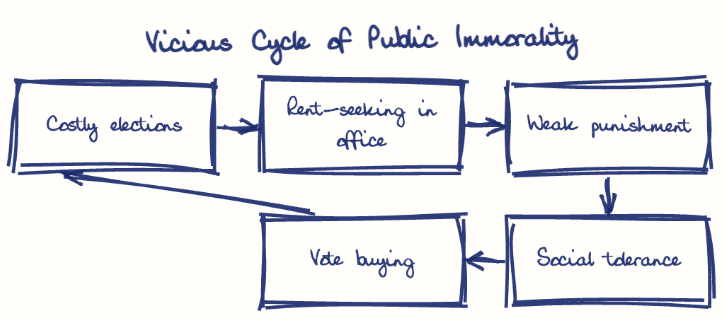
Public morality in India has declined because weak legal deterrence, criminalised and money-driven politics, social tolerance of corruption and a feudal gift culture reinforce one another. A record 251 of 543 Lok Sabha members elected in 2024 declared criminal cases, as per ADR.
Model answer
Ghissu Editorial · Verified 4 Oct 2026 · 275 words
Weak deterrence
Slow trials under the Prevention of Corruption Act, 1988 and the prior sanction under Section 17A (2018) dilute punishment.
Hollow watchdogs
The Lokpal functioned only from 2019, and the Whistle Blowers Protection Act, 2014 is still not in force.
Criminalisation
A record 251 of 543 Lok Sabha members elected in 2024 (46%) declared criminal cases (ADR), the nexus the Vohra Committee (1993) warned of.
Money power
Costly, opaque election funding drives rent-seeking and hides quid pro quo from voters, which is why the Supreme Court struck down electoral bonds in 2024.
Tolerance of corruption
"Speed money" is accepted as necessity, Gunnar Myrdal's "soft state" (1968) where rules are neither obeyed nor enforced.
Materialism
Wealth confers prestige whatever its source, and dowry and lavish weddings add pressure for illicit income.
Kinship over impartiality
Caste and kin loyalties legitimise favours in jobs and contracts.
Feudal and gift culture
A "mai-baap sarkar" mindset, VIP culture and the blurred line between gift and bribe normalise privilege, Gandhi's "politics without principle".
This model answer is indicative and the model can make mistakes; please verify key facts independently.
Practise this question
1Get the answer sheet
Sized for this question.
2Write your answer
Timed, by hand.
3Get it marked
Your score and what to fix.
This chapter in the exam
Transparency & Accountability, Institutional and Other Measures4 questions
Asked in 4 of 14 sittings since 2013
- 2026“Transparency and accountability in governance are not about controlling corruption but about creating the trust of stakeholders in the policy process by following the Rule of Law and Participatory Governance.” Comment.
- 2020Recent amendments to the Right to information Act will have profound impact on the autonomy and independence of the Information Commission. Discuss.
All 4 questions, sorted by sub-topic, with model answers and practice.
Question from the official UPSC Civil Services (Main) Examination 2016 paper. Answer written by Ghissu's engine and checked against our editorial standards. Found an error? Tell us and we correct it within 48 hours.