2016 · GS Paper 3 · Q8 · 12 marks
What is allelopathy? Discuss its role in major cropping systems of irrigated agriculture.
In short
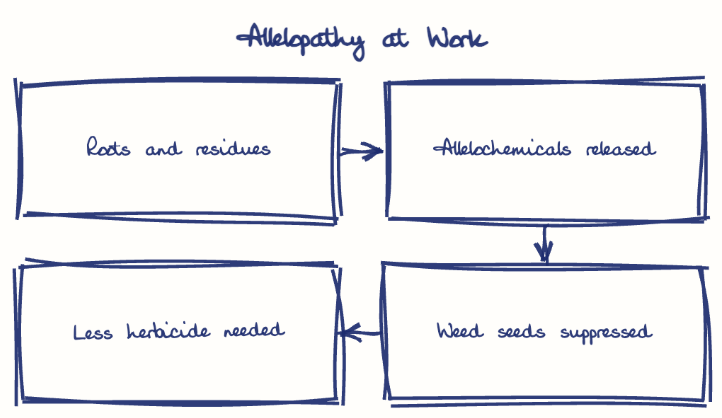
Allelopathy is the effect of one plant on another through chemicals released from roots and residues, and in irrigated systems it both suppresses weeds and depresses crops. Rice roots exude momilactone B against barnyard grass, while freshly incorporated rice straw can depress wheat germination.
Model answer
Ghissu Editorial · Verified 4 Oct 2026 · 268 words
Allelopathic rice
Rice roots exude momilactone B, which suppresses barnyard grass, one of the worst weeds of paddy, so weed-suppressive cultivars can cut weeding costs in the rice-wheat belt.
Mulches for wheat
Where Phalaris minor turned resistant to isoproturon in Punjab and Haryana, sorghum and sunflower residues, and sorghum water extract (sorgaab), let farmers lower the herbicide dose.
Brassica break crops
Mustard residues release isothiocyanates that suppress soil pathogens and nematodes, a biofumigation effect that makes mustard a useful rotation crop in irrigated north-west India.
Residue toxicity
Phenolic acids from rice straw incorporated just before sowing can depress wheat germination, so residue timing decides whether straw is a mulch or a yield drag.
Crop autotoxicity
Yield decline in successive sugarcane ratoons is partly attributed to the crop's own residues, an argument for rotation with pulses.
Weeds and bund trees
Parthenin from Parthenium and leachates from boundary eucalyptus inhibit the germination and growth of adjoining crops.
This model answer is indicative and the model can make mistakes; please verify key facts independently.
Practise this question
1Get the answer sheet
Sized for this question.
2Write your answer
Timed, by hand.
3Get it marked
Your score and what to fix.
This chapter in the exam
Major Crops and Cropping Patterns10 questions
Asked in 10 of 14 sittings since 2013
- 2026How Indian agriculture has been transformed from food scarcity to food surplus level? Explain the various government policies implemented for diversification of Indian agriculture. (Answer in 250 words)
- 2025Explain the factors influencing the decision of the farmers on the selection of high value crops in India.
All 10 questions, sorted by sub-topic, with model answers and practice.
Question from the official UPSC Civil Services (Main) Examination 2016 paper. Answer written by Ghissu's engine and checked against our editorial standards. Found an error? Tell us and we correct it within 48 hours.