2016 · GS Paper 4 · Q5(b) · 5 marks
Law and ethics are considered to be the two tools for controlling human conduct so as to make it conducive to civilized social existence. Giving examples, show how the two differ in their approaches.
In short
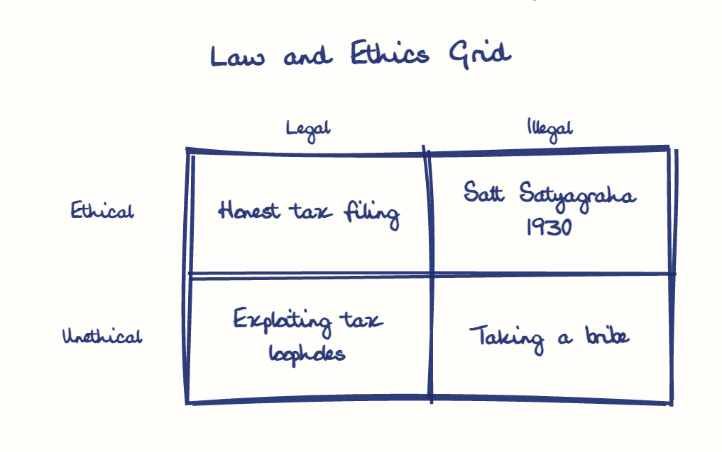
Law controls conduct through external, state-made commands enforced by punishment, while ethics works through conscience, motive and social censure and asks for an ideal beyond the legal minimum. Gandhi's Salt Satyagraha (1930) was illegal yet ethical, while exploiting tax loopholes is legal yet unethical.
Model answer
Ghissu Editorial · Verified 4 Oct 2026 · 278 words
Source
Law is made by Parliament, delegated rule-makers and courts; ethics springs from conscience, philosophy and custom and needs no enactment.
Sanction
A bribe brings prison under the Prevention of Corruption Act, 1988, while an ethical lapse brings guilt or social censure.
Act versus intention
Law judges proven acts, ethics weighs motive; for Kant, an official honest only out of fear of audit is lawful but not yet moral.
Fixed versus evolving
Casino gambling is licensed in Goa but barred in most states, and Section 377 changed only with Navtej Singh Johar (2018); ethics claims universal reach.
Minimum versus ideal
No law compels a passer-by to help an accident victim; ethics does, and law could only shield Good Samaritans through Section 134A of the Motor Vehicles Act in 2019.
Command versus aspiration
The Senior Citizens Act, 2007 can compel maintenance of parents, but not the care that filial duty asks.
Reading the gaps
Gandhi broke an unjust salt law for a higher justice, while aggressive tax avoidance stays legal yet erodes fairness.
This model answer is indicative and the model can make mistakes; please verify key facts independently.
Practise this question
1Get the answer sheet
Sized for this question.
2Write your answer
Timed, by hand.
3Get it marked
Your score and what to fix.
This chapter in the exam
Laws, rules, regulations and conscience as sources of ethical guidance16 questions
Asked in 9 of 14 sittings since 2013
- 2026Dr. B. R. Ambedkar had cautioned that employing civil disobedience within a constitutional democracy equates to endorsing 'anarchy'. How should modern democracies navigate the ethical dilemmas posed by civil disobedience movements that aim to promote social justice against policies that may raise genuine concerns?
- 2026Usually schools, working in remote areas, do not fully comply with government regulations. However, if the rules are enforced strictly, it would lead to most schools closing down. How should an administrator strike a balance between enforcement of rules and educational rights of children?
All 16 questions, sorted by sub-topic, with model answers and practice.
Question from the official UPSC Civil Services (Main) Examination 2016 paper. Answer written by Ghissu's engine and checked against our editorial standards. Found an error? Tell us and we correct it within 48 hours.