2016 · GS Paper 4 · Q8 · 10 marks
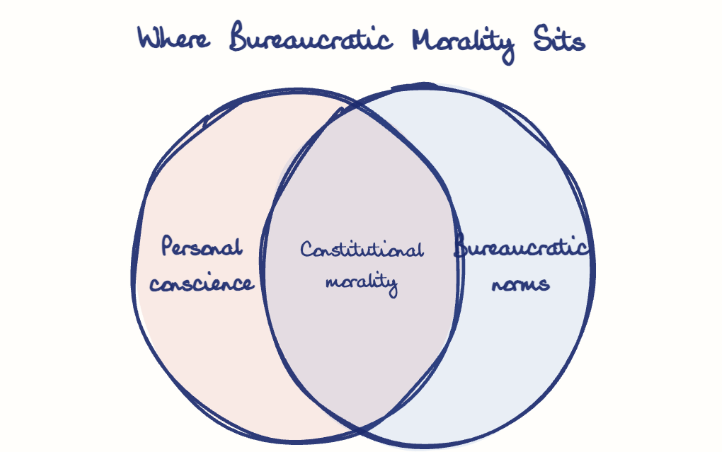
"Max Weber said that it is not wise to apply to public administration the sort of moral and ethical norms we apply to matters of personal conscience. It is important to realise that the State bureaucracy might possess its own independent bureaucratic morality." Critically analyse this statement.
In short
Weber is right that public officials cannot act on private conscience alone, but bureaucratic morality cannot be independent of ethics because it is bound by constitutional morality. The Shah Commission (1978) showed the danger when officials obeyed illegal Emergency orders.
Model answer
Ghissu Editorial · Verified 4 Oct 2026 · 273 words
Impersonality ensures fairness
A registrar who let personal faith decide an inter-faith marriage under the Special Marriage Act, 1954 would replace the rule of law with the rule of persons.
Ethic of responsibility
Weber's ethic of responsibility, framed for leaders, judges acts by consequences rather than conviction; an official answers for consequences touching millions, so lawful policy must outrank private preference, and non-partisanship lets one service serve every government.
Banality of evil
Hannah Arendt's account of Eichmann (1963) showed a dutiful clerk administering genocide, and the Nuremberg principles refused "superior orders" as a defence.
The Indian warning
The Shah Commission (1978) found officials obeying illegal Emergency orders, a case of conscience laundering through hierarchy.
A higher norm binds it
The 2014 amendment to the All India Services (Conduct) Rules requires officers to uphold the supremacy of the Constitution, and Ashok Khemka's 2012 cancellation of a contested Gurugram land mutation shows conscience at work where rules are silent.
This model answer is indicative and the model can make mistakes; please verify key facts independently.
Practise this question
1Get the answer sheet
Sized for this question.
2Write your answer
Timed, by hand.
3Get it marked
Your score and what to fix.
This chapter in the exam
Public/Civil service values and Ethics in Public Administration — Status and problems5 questions
Asked in 5 of 14 sittings since 2013
- 2026Efficiency is doing things right, while effectiveness is doing the right thing. How do you strike a balance between the two to enhance productivity?
- 2025To achieve holistic development goal, a civil servant acts as an enabler and active facilitator of growth rather than a regulator. What specific measures will you suggest to achieve this goal?
All 5 questions, sorted by sub-topic, with model answers and practice.
Question from the official UPSC Civil Services (Main) Examination 2016 paper. Answer written by Ghissu's engine and checked against our editorial standards. Found an error? Tell us and we correct it within 48 hours.