2016 · GS Paper 4 · Q6(a) · 5 marks
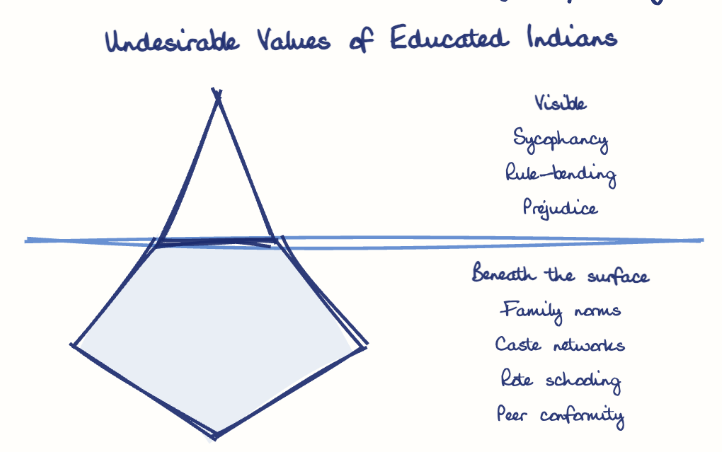
Our attitudes towards life, work, other people and society are generally shaped unconsciously by the family and the social surroundings in which we grow up. Some of these unconsciously acquired attitudes and values are often undesirable in the citizens of a modern democratic and egalitarian society. Discuss such undesirable values prevalent in today's educated Indians.
In short
Many educated Indians still carry unconsciously absorbed values such as caste consciousness, patriarchy, contempt for manual labour, tolerance of petty corruption and parochialism that contradict constitutional equality. The India Human Development Survey (2011-12) found that 27% of households admitted practising untouchability in some form.
Model answer
Ghissu Editorial · Verified 4 Oct 2026 · 264 words
Caste consciousness
The India Human Development Survey (2011-12) found 27% of households admitting to untouchability in some form, and caste-based matrimonial advertisements show endogamy thriving among graduates.
Patriarchal conditioning
The sex ratio at birth of 929 girls per 1,000 boys (NFHS-5, 2019-21) and 5,737 dowry deaths recorded by NCRB in 2024 reveal son preference in educated homes too.
Deference to status
Sycophancy and VIP culture, targeted by the 2017 ban on red beacons, reflect the bhakti in politics Ambedkar called "a sure road to degradation."
Tolerance of petty corruption
A "chalta hai" acceptance of speed money and tax evasion is Gandhi's social sin of "knowledge without character."
Parochialism
Racial abuse of North-East citizens, which prompted the Bezbaruah Committee (2014) after Nido Tania's death, shows prejudice surviving education.
Contempt for labour and civic indifference
Disdain for sanitation and care work, and littering or low urban turnout, ignore the duties of Article 51A.
This model answer is indicative and the model can make mistakes; please verify key facts independently.
Practise this question
1Get the answer sheet
Sized for this question.
2Write your answer
Timed, by hand.
3Get it marked
Your score and what to fix.
This chapter in the exam
Role of family, society and educational institutions in inculcating values3 questions
Asked in 2 of 14 sittings since 2013
- 2020"Education is not an injunction, it is an effective and pervasive tool for all round development of an individual and social transformation". Examine the New Education Policy, 2020 (NEP, 2020) in light of the above statement.
- 2016Our attitudes towards life, work, other people and society are generally shaped unconsciously by the family and the social surroundings in which we grow up. Some of these unconsciously acquired attitudes and values are often undesirable in the citizens of a modern democratic and egalitarian society. How can such undesirable attitudes be changed and socio-ethical values considered necessary in public services be cultivated in the aspiring and serving civil servants?
Question from the official UPSC Civil Services (Main) Examination 2016 paper. Answer written by Ghissu's engine and checked against our editorial standards. Found an error? Tell us and we correct it within 48 hours.