2020 · GS Paper 4 · Q1(b) · 10 marks
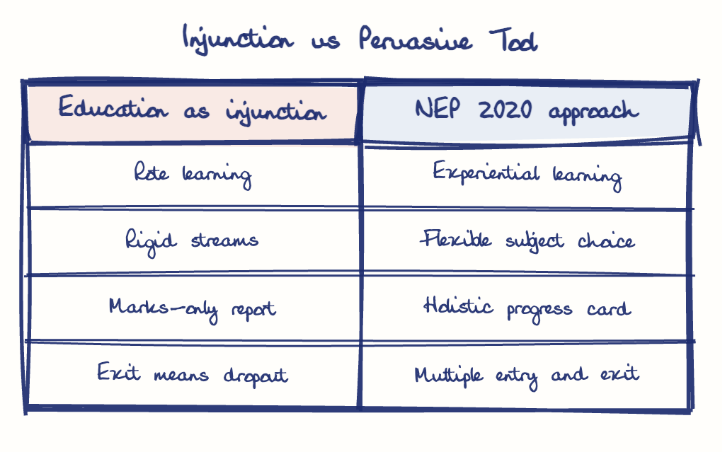
"Education is not an injunction, it is an effective and pervasive tool for all round development of an individual and social transformation". Examine the New Education Policy, 2020 (NEP, 2020) in light of the above statement.
In short
NEP 2020 largely embodies the view of education as a pervasive tool rather than an injunction, through early childhood care, experiential and multidisciplinary learning, mother-tongue teaching and equity measures. Its impact is limited by spending below the policy's own target of 6% of GDP and by teacher shortages.
Model answer
Ghissu Editorial · Verified 4 Oct 2026 · 291 words
Whole-child foundation
The 5+3+3+4 structure brings early childhood care into schooling, and NIPUN Bharat (2021) targets foundational literacy and numeracy by Grade 3.
Head, hand and heart
Vocational exposure from Grade 6, parity for arts and sport, and constitutional values in the curriculum build skills and character together.
Understanding over recall
Mother-tongue teaching until at least Grade 5 and competency-based assessment through PARAKH reward application, not memory.
Equity by design
Special Education Zones, a Gender Inclusion Fund and a 50% higher-education enrolment target for 2035 aim at children whom caste, gender and geography have long kept out.
Funding and teacher gaps
Public spending stays well below the policy's 6% of GDP target, and rural teacher shortages persist, limiting what any curriculum can achieve.
Federal and digital frictions
Tamil Nadu's refusal to sign the PM SHRI agreement over the three-language formula, and the digital divide exposed by COVID-19, show that transformation needs consensus and access.
This model answer is indicative and the model can make mistakes; please verify key facts independently.
Practise this question
1Get the answer sheet
Sized for this question.
2Write your answer
Timed, by hand.
3Get it marked
Your score and what to fix.
This chapter in the exam
Role of family, society and educational institutions in inculcating values3 questions
Asked in 2 of 14 sittings since 2013
- 2016Our attitudes towards life, work, other people and society are generally shaped unconsciously by the family and the social surroundings in which we grow up. Some of these unconsciously acquired attitudes and values are often undesirable in the citizens of a modern democratic and egalitarian society. Discuss such undesirable values prevalent in today's educated Indians.
- 2016Our attitudes towards life, work, other people and society are generally shaped unconsciously by the family and the social surroundings in which we grow up. Some of these unconsciously acquired attitudes and values are often undesirable in the citizens of a modern democratic and egalitarian society. How can such undesirable attitudes be changed and socio-ethical values considered necessary in public services be cultivated in the aspiring and serving civil servants?
Question from the official UPSC Civil Services (Main) Examination 2020 paper. Answer written by Ghissu's engine and checked against our editorial standards. Found an error? Tell us and we correct it within 48 hours.