2016 · GS Paper 4 · Q6(b) · 5 marks
Our attitudes towards life, work, other people and society are generally shaped unconsciously by the family and the social surroundings in which we grow up. Some of these unconsciously acquired attitudes and values are often undesirable in the citizens of a modern democratic and egalitarian society. How can such undesirable attitudes be changed and socio-ethical values considered necessary in public services be cultivated in the aspiring and serving civil servants?
In short
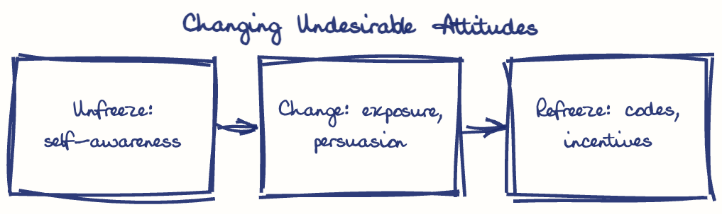
Undesirable attitudes can be changed through self-audit, contact with other groups, role models and lifelong training, and refrozen through codes, incentives and ethical leadership. Mission Karmayogi (2020) shifts civil-service training from rules to roles, with modules on citizen-centricity and sensitisation.
Model answer
Ghissu Editorial · Verified 4 Oct 2026 · 260 words
Self-audit through ethics
The Ethics, Integrity and Aptitude paper added to the UPSC Mains in 2013 makes aspirants confront their own biases through case studies, and reflective journaling turns that knowledge into self-awareness.
Contact and immersion
Allport's contact hypothesis explains why LBSNAA mixes trainees across states and services and sends them on village visits and Bharat Darshan.
Role models
Armstrong Pame's crowdfunded People's Road in Manipur (2012) persuades better than lectures because it moves feeling as well as reason.
Lifelong training
Mission Karmayogi (2020) and its iGOT platform shift training from rules to roles, with citizen-centricity and gender sensitisation modules.
Codes with consequences
The All India Services (Conduct) Rules, 1968 and the 2nd ARC's Ethics in Governance report (2007) make values explicit, while social audits attach costs to lapses.
Incentives and leadership
The PM's Awards for Excellence and 360-degree feedback reward good conduct, and seniors who model probity stop conscience laundering ("my superior asked me"), while CPGRAMS grievance data show where attitudes still fail citizens.
This model answer is indicative and the model can make mistakes; please verify key facts independently.
Practise this question
1Get the answer sheet
Sized for this question.
2Write your answer
Timed, by hand.
3Get it marked
Your score and what to fix.
This chapter in the exam
Role of family, society and educational institutions in inculcating values3 questions
Asked in 2 of 14 sittings since 2013
- 2020"Education is not an injunction, it is an effective and pervasive tool for all round development of an individual and social transformation". Examine the New Education Policy, 2020 (NEP, 2020) in light of the above statement.
- 2016Our attitudes towards life, work, other people and society are generally shaped unconsciously by the family and the social surroundings in which we grow up. Some of these unconsciously acquired attitudes and values are often undesirable in the citizens of a modern democratic and egalitarian society. Discuss such undesirable values prevalent in today's educated Indians.
Question from the official UPSC Civil Services (Main) Examination 2016 paper. Answer written by Ghissu's engine and checked against our editorial standards. Found an error? Tell us and we correct it within 48 hours.