2017 · GS Paper 1 · Q19 · 15 marks
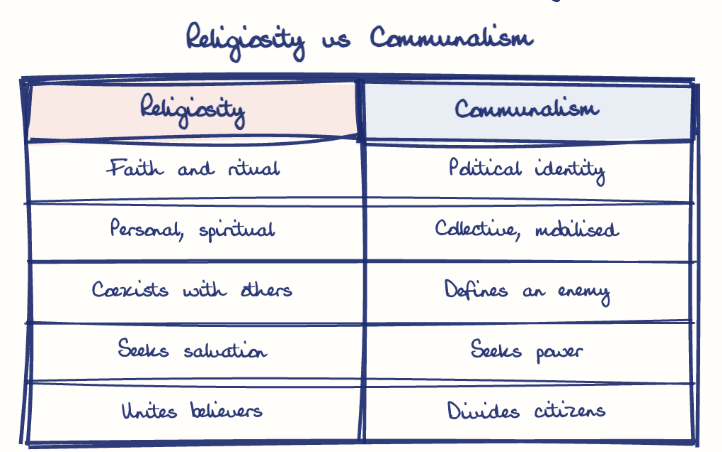
Distinguish between religiousness/religiosity and communalism giving one example of how the former has got transformed into the latter in independent India.
In short
Religiosity is personal devotion to belief and ritual, while communalism is the political ideology that a religion's followers share interests opposed to other communities. The Ayodhya movement shows the shift, as devotion to Ram became a mass political identity that culminated in the 1992 demolition and riots.
Model answer
Ghissu Editorial · Verified 4 Oct 2026 · 289 words
Belief versus ideology
Religiosity is devotion to belief and ritual; communalism, in Bipan Chandra's words, holds that a religion's followers share secular interests opposed to others.
Devotion without hostility
Gandhi was deeply religious yet fought communalism, singing "Ishwar Allah tero naam" and walking through riot-torn Noakhali in 1946.
Constitutional line
Article 25 protects religion, but Abhiram Singh (2017) made religious vote appeals a corrupt practice under Section 123(3) of the RPA.
Symbol turned into mobilisation
Long-standing devotion to Ram became a mass political identity through the 1980s Ram Janmabhoomi campaign and Advani's 1990 Rath Yatra.
Identity turned into violence
The 1992 demolition triggered the Mumbai riots documented by the Srikrishna Commission, and Liberhan (2009) found it planned.
Law reasserted
In M. Siddiq (2019) the Supreme Court called the demolition an egregious violation of the rule of law.
Even-handed enforcement and civic bridges
Apply Section 123(3) and the Tehseen Poonawalla (2018) guidelines evenly, and build inter-faith associations, which Varshney found kept Calicut peaceful.
This model answer is indicative and the model can make mistakes; please verify key facts independently.
Practise this question
1Get the answer sheet
Sized for this question.
2Write your answer
Timed, by hand.
3Get it marked
Your score and what to fix.
This chapter in the exam
Communalism3 questions
Asked in 3 of 14 sittings since 2013
Question from the official UPSC Civil Services (Main) Examination 2017 paper. Answer written by Ghissu's engine and checked against our editorial standards. Found an error? Tell us and we correct it within 48 hours.