2023 · GS Paper 1 · Q20 · 15 marks
Discuss the impact of post-liberal economy on ethnic identity and communalism.
In short
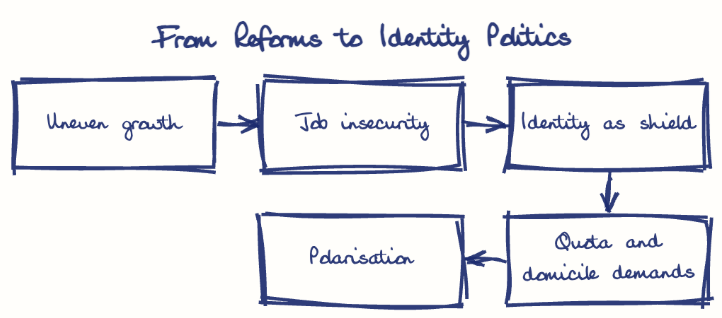
The post-liberal economy has loosened ascriptive identities through mobility and markets, but its uneven, jobless growth has made ethnic and religious identity a shield against insecurity, feeding nativism, quota agitations and communal polarisation. Haryana's 2020 law reserving 75% of private jobs for locals shows the sons-of-the-soil revival.
Model answer
Ghissu Editorial · Verified 4 Oct 2026 · 279 words
Sons of the soil revived
Haryana's 2020 law reserving 75% of private jobs for locals, struck down in 2023, reflects jobless growth.
Dominant castes seek quotas
Agrarian distress drove the Patidar (2015), Jat (2016) and Maratha agitations for secure jobs.
Resource frontier conflicts
Dongria Kondh gram sabhas rejected Vedanta's Niyamgiri mine after the 2013 Supreme Court ruling.
Identity loosened and marketed
Urban anonymity and Dalit enterprise through DICCI loosen ascriptive bonds, while GI tags and the Hornbill Festival market identity itself.
Insecurity finds scapegoats
Insecure urban work makes it easier to blame the religious "other", as boycott calls against minority traders show.
Segregation and digital polarisation
Enclaves such as Juhapura in Ahmedabad freeze segregation, and cheap data after 2016 spread rumours behind the 2017-18 lynchings, prompting the Tehseen Poonawalla guidelines (2018).
Interdependence as a brake
Varanasi's Hindu silk traders and Muslim weavers, like Varshney's Calicut, show markets binding communities.
Jobs and consent
Labour-intensive manufacturing, PESA and Forest Rights Act enforcement, and even-handed policing under Prakash Singh (2006) reduce the insecurity that identity politics feeds on.
This model answer is indicative and the model can make mistakes; please verify key facts independently.
Practise this question
1Get the answer sheet
Sized for this question.
2Write your answer
Timed, by hand.
3Get it marked
Your score and what to fix.
This chapter in the exam
Communalism3 questions
Asked in 3 of 14 sittings since 2013
Question from the official UPSC Civil Services (Main) Examination 2023 paper. Answer written by Ghissu's engine and checked against our editorial standards. Found an error? Tell us and we correct it within 48 hours.