2018 · GS Paper 1 · Q20 · 15 marks
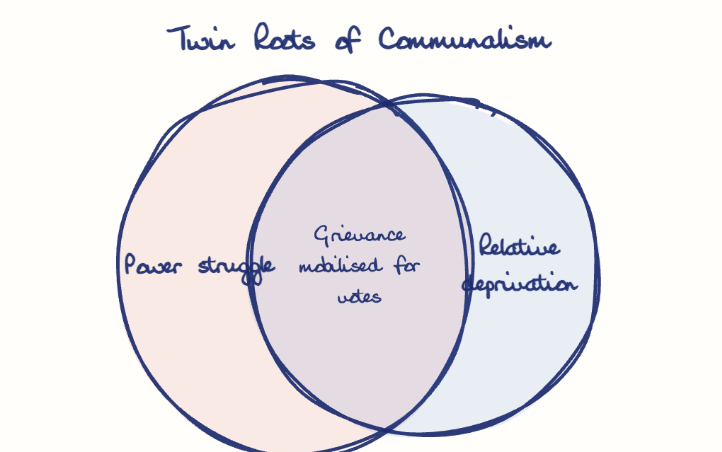
Communalism arises either due to power struggle or relative deprivation.' Argue by giving suitable illustrations.
In short
Communalism in India grows from both power struggles, where elites mobilise religion for votes, and relative deprivation, where groups feel left behind, and the two usually act together. Steven Wilkinson's 2004 study showed riots are likelier where elections are close and governments do not need minority votes.
Model answer
Ghissu Editorial · Verified 4 Oct 2026 · 274 words
Colonial divide and rule
Separate electorates (1909) and the Communal Award (1932) made religion the route to power, ending in Partition.
Electoral arithmetic
Steven Wilkinson (2004) showed riots are likelier where elections are close and governments do not need minority votes.
Riots before ballots
The 2013 Muzaffarnagar riots, inflamed by a doctored video before the 2014 election, polarised western Uttar Pradesh.
Minority deprivation
The Sachar Committee (2006) found Muslims, 13.4% of the population, held about 3% of IAS posts.
Majority's perceived loss
The "appeasement" narrative makes sections of the majority feel cheated, relative deprivation in its purest form.
Competition for land
Kandhamal (2008) pitted Kandha tribals against Christian Pana Dalits over ST status and land, and Kokrajhar (2012) set Bodos against Bengali-speaking Muslims.
Two causes fused
Leaders turn grievance into votes, so the "either-or" is too narrow; historical memory and external backing, as for Khalistani militancy, also matter.
Neutral policing and inclusion
Implement the Prakash Singh (2006) police reforms, track the New 15-Point Programme, and build inter-faith associations that Varshney found kept Calicut peaceful.
This model answer is indicative and the model can make mistakes; please verify key facts independently.
Practise this question
1Get the answer sheet
Sized for this question.
2Write your answer
Timed, by hand.
3Get it marked
Your score and what to fix.
This chapter in the exam
Communalism3 questions
Asked in 3 of 14 sittings since 2013
Question from the official UPSC Civil Services (Main) Examination 2018 paper. Answer written by Ghissu's engine and checked against our editorial standards. Found an error? Tell us and we correct it within 48 hours.