2017 · GS Paper 1 · Q12 · 15 marks
Examine how the decline of traditional artisanal industry in colonial India crippled the rural economy.
In short
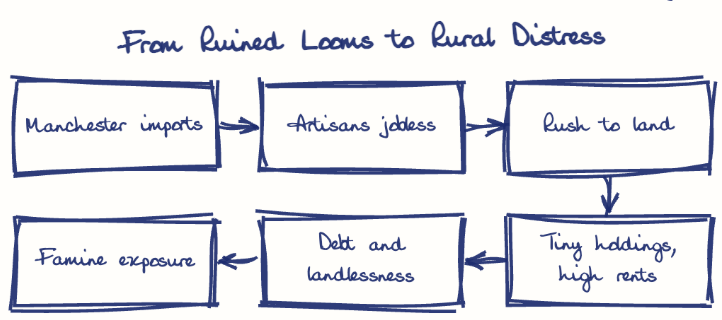
The decline of traditional crafts under one-way free trade crippled the rural economy by pushing jobless artisans onto land, breaking the artisan-village nexus and deepening debt, landlessness and famine exposure. Amiya Bagchi found Gangetic Bihar's industrial workforce fell from 18.6% in 1809-13 to 8.5% by 1901.
Model answer
Ghissu Editorial · Verified 4 Oct 2026 · 287 words
One-way free trade
After 1813, Manchester cloth entered India almost duty-free while Indian textiles faced heavy British tariffs.
Loss of patronage and coercion
Princely courts declined, elites took to Western goods, and Company agents forced Bengal weavers into below-cost contracts.
Pressure on land
Amiya Kumar Bagchi found the share of industrial workers in Gangetic Bihar fell from 18.6% in 1809-13 to 8.5% by 1901, while Census data show dependence on agriculture rising to 70% by 1941.
Broken artisan-village nexus
Jajmani exchange unravelled and households lost spinning income, much of it women's work.
Fragmentation and debt
Tiny holdings, rising rents and moneylenders created disguised unemployment and landless labourers.
Famine exposure
With no non-farm income, the famines of 1876-78 and 1896-1900 struck artisan and peasant alike.
Swadeshi and khadi
The 1905 movement and Gandhi's charkha made rural crafts a symbol of self-reliance.
Village industries
The Khadi and Village Industries Commission, created under a 1956 Act, sought to rebuild non-farm rural work, the lesson being that a village resting on land alone stays fragile.
This model answer is indicative and the model can make mistakes; please verify key facts independently.
Practise this question
1Get the answer sheet
Sized for this question.
2Write your answer
Timed, by hand.
3Get it marked
Your score and what to fix.
This chapter in the exam
Colonialism4 questions
Asked in 4 of 14 sittings since 2013
- 2022Why was there a sudden spurt in famines in colonial India since the mid-eighteenth century? Give reasons.
- 2018Why indentured labour was taken by the British from India to other colonies? Have they been able to preserve their cultural identity over there?
All 4 questions, sorted by sub-topic, with model answers and practice.
Question from the official UPSC Civil Services (Main) Examination 2017 paper. Answer written by Ghissu's engine and checked against our editorial standards. Found an error? Tell us and we correct it within 48 hours.