2017 · GS Paper 1 · Q15 · 15 marks
Petroleum refineries are not necessarily located nearer to crude oil producing areas, particularly in many of the developing countries. Explain its implications.
In short
Refineries in developing countries locate near ports and markets because crude is cheaper to move than its many products, which builds refining and exports but deepens import dependence and coastal risk. India imported about 88% of its crude in 2024-25 yet runs Jamnagar, the largest single-site refinery.
Model answer
Ghissu Editorial · Verified 4 Oct 2026 · 260 words
Refining without oilfields
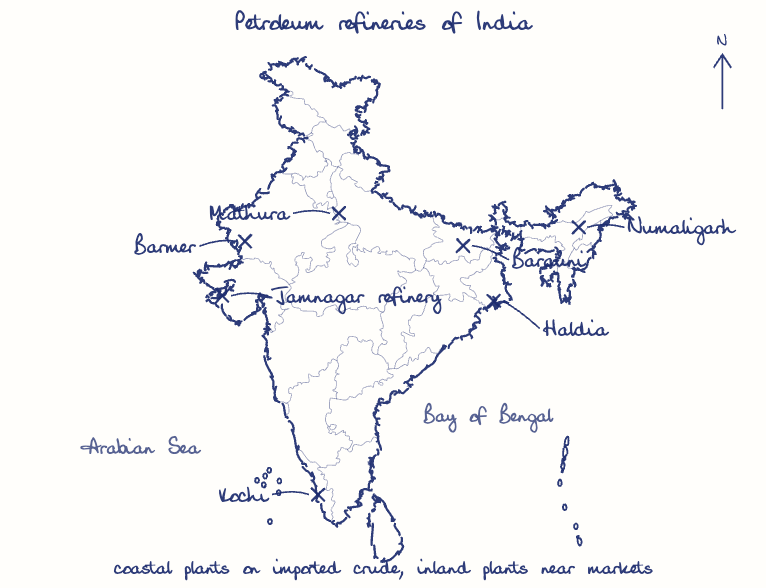
Singapore and India's Jamnagar complex, the world's largest single-site refinery, run on imported crude.

Market-led distribution
The Mathura refinery gets coastal crude through the Salaya-Mathura pipeline and serves north India directly.
Value addition and flexibility
Coastal refineries anchor PCPIRs like Dahej and Paradip, make India a net product exporter, and could switch to discounted Russian crude after 2022.
Import dependence
The trade balance rides on oil prices and sea lanes such as Hormuz and the Red Sea.
Lost value for producers
Nigeria long exported crude and imported fuel until the Dangote refinery opened in 2024; Assam won Numaligarh under the Assam Accord.
Ecology and security
The December 2023 Ennore oil leak shows coastal risk, and concentrated, import-fed capacity leans on only 5.33 million tonnes of strategic reserves.
Diversify and store
Widen crude sources and expand strategic reserves.
Greener and local
Refine domestic crude near Barmer, and use green hydrogen and 20% ethanol blending to cut crude demand.
This model answer is indicative and the model can make mistakes; please verify key facts independently.
Practise this question
1Get the answer sheet
Sized for this question.
2Write your answer
Timed, by hand.
3Get it marked
Your score and what to fix.
This chapter in the exam
Resources and planning38 questions
Asked in 14 of 14 sittings since 2013
- 2026"Water resources are both an asset and a source of conflict in South Asia." Examine this statement giving examples.
- 2026Analyze the role of satellite-based technologies in achieving climate-smart agriculture and food security in India.
All 38 questions, sorted by sub-topic, with model answers and practice.
Question from the official UPSC Civil Services (Main) Examination 2017 paper. Answer written by Ghissu's engine and checked against our editorial standards. Found an error? Tell us and we correct it within 48 hours.