2017 · GS Paper 1 · Q11 · 15 marks
The spirit of tolerance and love is not only an interesting feature of Indian society from very early times, but it is also playing an important part at the present. Elaborate.
In short
India's spirit of tolerance and love runs from Vedic pluralism, Ashoka's edicts, Bhakti-Sufi saints and Akbar's sulh-i-kul to today's constitutional secularism and shared practices. Articles 25 to 28, the Article 51A(e) duty of brotherhood and S.R. Bommai (1994) entrench it in present-day India.
Model answer
Ghissu Editorial · Verified 4 Oct 2026 · 284 words
Pluralist philosophy
The Rigveda's "Ekam sat vipra bahudha vadanti" and Jain anekantavada made plurality of belief a principle.
Concord as state policy
Ashoka's Rock Edict XII urged honour for other sects, and Akbar's sulh-i-kul and Ibadat Khana (1575) sought common ground between faiths.
Bhakti, Sufis and refuge
Kabir, Guru Nanak and the Chishtis preached love beyond caste and creed, while Parsis at Sanjan and Jews in Kochi found shelter.
Constitutional secularism
Articles 25 to 28 protect every faith, Article 51A(e) makes common brotherhood a duty, and S.R. Bommai (1994) placed secularism in the basic structure.
Everyday shared practice
The Golden Temple's langar feeds all comers, and places of worship of every faith sheltered victims of the 2018 Kerala floods.
Soft power
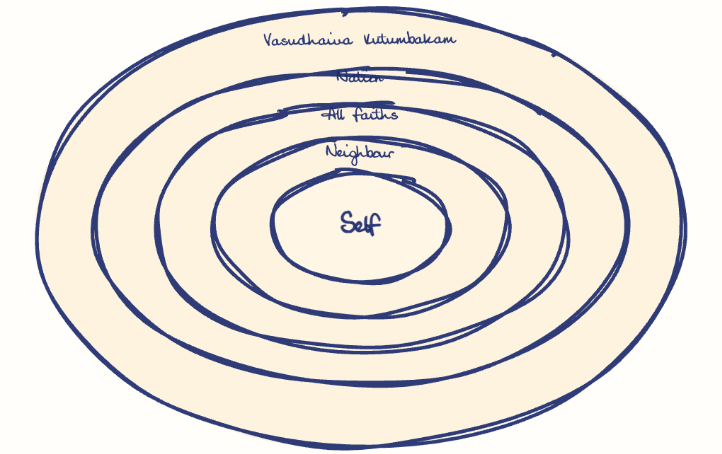
India's "Buddha, not Yuddha" message at the UN (2019), refuge for Tibetans since 1959 and its 2023 G20 theme of Vasudhaiva Kutumbakam project the ethos abroad.
Enforce and build bridges
Implement the Tehseen Poonawalla (2018) anti-lynching directions, replicate Bhiwandi's mohalla committees, and teach pluralism through Article 51A(e) in schools.
This model answer is indicative and the model can make mistakes; please verify key facts independently.
Practise this question
1Get the answer sheet
Sized for this question.
2Write your answer
Timed, by hand.
3Get it marked
Your score and what to fix.
This chapter in the exam
Art Forms10 questions
Asked in 8 of 14 sittings since 2013
- 2025The sculptors filled the Chandella artform with resilient vigor and breadth of life.' Elucidate.
- 2022Discuss the significance of the lion and bull figures in Indian mythology, art and architecture.
All 10 questions, sorted by sub-topic, with model answers and practice.
Question from the official UPSC Civil Services (Main) Examination 2017 paper. Answer written by Ghissu's engine and checked against our editorial standards. Found an error? Tell us and we correct it within 48 hours.