2017 · GS Paper 1 · Q18 · 15 marks
The women’s questions arose in modern India as a part of the 19th century social reform movement. What were the major issues and debates concerning women in that period?
In short
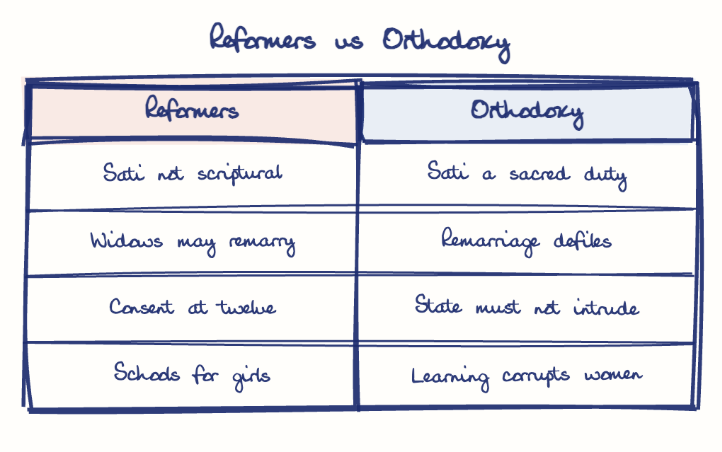
The nineteenth-century women's question centred on sati, enforced widowhood, child marriage, female education and purdah, debated as scripture versus reason and colonial law versus self-reform. It produced the sati ban (1829), the Widow Remarriage Act (1856) and the Age of Consent Act (1891).
Model answer
Ghissu Editorial · Verified 4 Oct 2026 · 302 words
Sati and widowhood
Rammohan Roy's campaign ended sati in 1829, and Vidyasagar, citing the Parashara Smriti, won the Widow Remarriage Act of 1856, though few widows remarried.
Child marriage
Malabari's campaign, Rukhmabai's case and Phulmoni's death produced the Age of Consent Act of 1891, raising the age from 10 to 12.
Education and purdah
The Phules' Pune school (1848), Bethune School (1849) and Pandita Ramabai's Sharada Sadan (1889) challenged seclusion.
Scripture or reason
Rammohan and Vidyasagar argued from the shastras, Phule from equality, so the debate was often about texts rather than women's wishes.
Colonial law or self-reform
Tilak opposed the 1891 Act as foreign interference, while Ranade's National Social Conference (1887) put social reform first.
Purpose of education
Partha Chatterjee shows nationalists cast the educated woman as guardian of a spiritual home, a better wife rather than a free citizen.
Women's own voices
Tarabai Shinde's Stri Purush Tulana (1882) and Ramabai's The High-Caste Hindu Woman (1887) made women participants, not the ground.
Agency with law
Consult women directly and back laws with schools and livelihoods, as the weak Sarda Act (1929) showed.
This model answer is indicative and the model can make mistakes; please verify key facts independently.
Practise this question
1Get the answer sheet
Sized for this question.
2Write your answer
Timed, by hand.
3Get it marked
Your score and what to fix.
This chapter in the exam
Socio-Religious Reform Movements4 questions
Asked in 4 of 14 sittings since 2013
- 2025Mahatma Jotirao Phule's writings and efforts of social reforms touched issues of almost all subaltern classes. Discuss.
- 2021Trace the rise and growth of socio-religious reform movements with special reference to Young Bengal and Brahmo Samaj.
All 4 questions, sorted by sub-topic, with model answers and practice.
Question from the official UPSC Civil Services (Main) Examination 2017 paper. Answer written by Ghissu's engine and checked against our editorial standards. Found an error? Tell us and we correct it within 48 hours.