2025 · GS Paper 1 · Q11 · 15 marks
Mahatma Jotirao Phule's writings and efforts of social reforms touched issues of almost all subaltern classes. Discuss.
In short
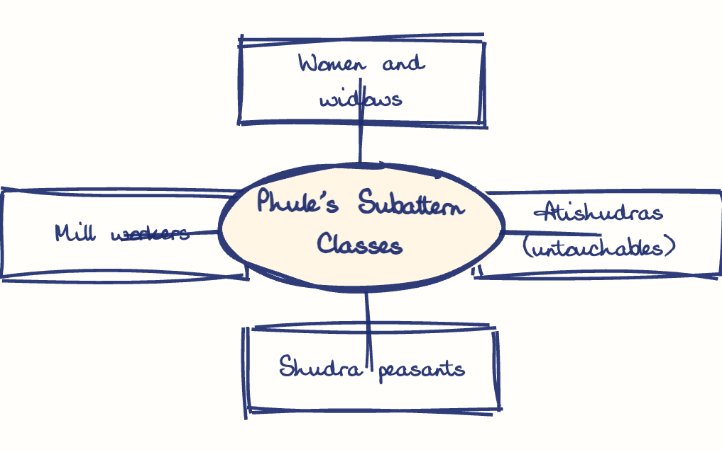
Phule's writings and reforms reached almost every subaltern group, from untouchables and widows to Shudra peasants and mill workers, though Adivasis, minorities and regions beyond western India got little attention. His Gulamgiri (1873) compared caste to slavery, and the Satyashodhak Samaj (1873) organised the lower castes.
Model answer
Ghissu Editorial · Verified 4 Oct 2026 · 261 words
Atishudras
Gulamgiri (1873) compared caste to slavery, and Phule opened schools for Mahar and Mang children and his water tank to untouchables in 1868.
Women and widows
With Savitribai he opened a girls' school in Pune in 1848 and founded the Balhatya Pratibandhak Griha (1863) for pregnant widows.
Shudra peasants
Shetkaryacha Asud (1883) exposed how priests, moneylenders, revenue officials and forest rules together fleeced the kunbi cultivator.
Education
Before the Hunter Commission in 1882 he demanded free, compulsory primary education and teachers from the lower castes.
Organised assertion
The Satyashodhak Samaj (1873) ran priestless marriages, and his associate Narayan Meghaji Lokhande organised Bombay mill hands.
Gaps
Adivasis, religious minorities and regions beyond western India received little attention, and his Aryan-invasion framing is contested.
Unfinished agenda
Article 21A and Ambedkar's dedication of Who Were the Shudras? (1946) to Phule show his agenda of education and equality living on.
This model answer is indicative and the model can make mistakes; please verify key facts independently.
Practise this question
1Get the answer sheet
Sized for this question.
2Write your answer
Timed, by hand.
3Get it marked
Your score and what to fix.
This chapter in the exam
Socio-Religious Reform Movements4 questions
Asked in 4 of 14 sittings since 2013
- 2021Trace the rise and growth of socio-religious reform movements with special reference to Young Bengal and Brahmo Samaj.
- 2019Examine the linkages between the nineteenth century’s ‘Indian Renaissance’ and the emergence of national identity.
All 4 questions, sorted by sub-topic, with model answers and practice.
Question from the official UPSC Civil Services (Main) Examination 2025 paper. Answer written by Ghissu's engine and checked against our editorial standards. Found an error? Tell us and we correct it within 48 hours.