2021 · GS Paper 1 · Q2 · 10 marks
Trace the rise and growth of socio-religious reform movements with special reference to Young Bengal and Brahmo Samaj.
In short
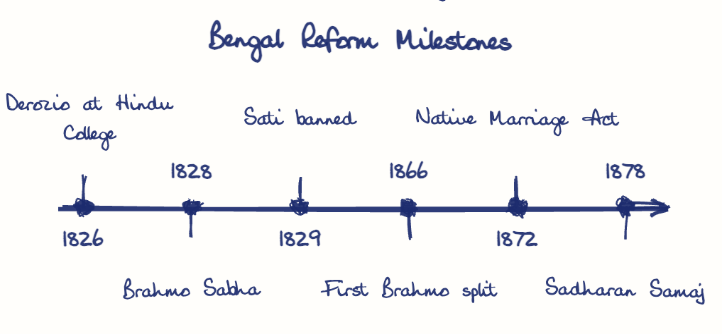
Nineteenth-century reform rose in colonial Calcutta from missionary challenge, English education and a new middle class, with the Brahmo Samaj reforming Hinduism from within and Young Bengal rejecting custom outright. Rammohan Roy's Brahmo Sabha (1828) helped end sati in 1829 and later won the Native Marriage Act of 1872.
Model answer
Ghissu Editorial · Verified 4 Oct 2026 · 295 words
Colonial challenge
Missionary critique from Serampore painted Hindu society as backward, pushing educated Indians to reform their own faith.
Education and print
Hindu College (1817), the vernacular press and the Asiatic Society's recovery of old texts created an English-educated bhadralok that led reform.
Spread across India
The impulse moved through the Prarthana Samaj (1867), Satyashodhak Samaj (1873), Arya Samaj (1875) and Sayyid Ahmad Khan's Aligarh school (1875).
Rammohan's Brahmo Samaj
Founded in 1828, it preached Upanishadic monotheism against idolatry and ritual, and its campaign helped Bentinck ban sati in 1829.
Growth through splits
Debendranath Tagore's Tattvabodhini Sabha revived it, Keshub Chandra Sen won the Native Marriage Act of 1872, and the Sadharan Brahmo Samaj broke away in 1878.
Young Bengal's radicalism
Derozio's Academic Association taught Hindu College students to question everything, so they defied caste and idolatry and backed women's rights.
Legacy and limits
Derozio was dismissed in 1831 and his followers found no mass base, though they later voiced ryots' grievances through the Bengal British India Society (1843).
This model answer is indicative and the model can make mistakes; please verify key facts independently.
Practise this question
1Get the answer sheet
Sized for this question.
2Write your answer
Timed, by hand.
3Get it marked
Your score and what to fix.
This chapter in the exam
Socio-Religious Reform Movements4 questions
Asked in 4 of 14 sittings since 2013
- 2025Mahatma Jotirao Phule's writings and efforts of social reforms touched issues of almost all subaltern classes. Discuss.
- 2019Examine the linkages between the nineteenth century’s ‘Indian Renaissance’ and the emergence of national identity.
All 4 questions, sorted by sub-topic, with model answers and practice.
Question from the official UPSC Civil Services (Main) Examination 2021 paper. Answer written by Ghissu's engine and checked against our editorial standards. Found an error? Tell us and we correct it within 48 hours.