2017 · GS Paper 2 · Q18 · 15 marks
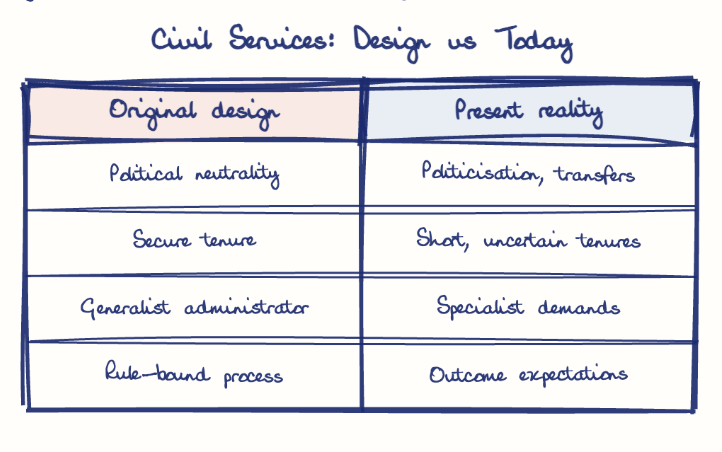
Initially Civil Services in India were designed to achieve the goals of neutrality and effectiveness, which seems to be lacking in the present context. Do you think drastic reforms are required in Civil Services? Comment.
In short
Neutrality and effectiveness in India's civil services have weakened, so reform is required, but it should be deep and systemic rather than a drastic overhaul of the constitutional steel frame. The Supreme Court's T.S.R. Subramanian judgment (2013) on Civil Services Boards and fixed tenures shows the direction.
Model answer
Ghissu Editorial · Verified 4 Oct 2026 · 287 words
Transfer as a weapon
Officers such as Ashok Khemka, moved over 50 times, show postings reward compliance, which led the Supreme Court in T.S.R. Subramanian (2013) to order Civil Services Boards and fixed tenures.
Effectiveness deficit
The 2nd ARC (2008) found that seniority promotion and generalist rotation leave officers without domain depth.
Case for deep change
Digital governance and climate tasks need specialists, hence lateral entry from 2018 and performance agreements proposed by the 2nd ARC.
Strength of the frame
The same services delivered DBT, the CoWIN vaccination drive and free elections.
Risks of radical surgery
Diluting Article 311 or mass lateral entry could invite patronage, as the August 2024 withdrawal of the lateral-entry advertisement showed.
Reform under way
Mission Karmayogi (2020) moves training "from rule to role", with over 75 lakh iGOT users in 2024-25 (DoPT).
Insulate and specialise
A Civil Services Act with statutory boards, mid-career domain assignment and 360-degree appraisal.
This model answer is indicative and the model can make mistakes; please verify key facts independently.
Practise this question
1Get the answer sheet
Sized for this question.
2Write your answer
Timed, by hand.
3Get it marked
Your score and what to fix.
This chapter in the exam
Role of Civil Services in a Democracy6 questions
Asked in 6 of 14 sittings since 2013
- 2026Analyse the advantages and limitations of the generalist structure of the Indian Civil Services in contemporary governance.
- 2024The Doctrine of Democratic Governance makes it necessary that the public perception of the integrity and commitment of civil servants becomes absolutely positive. Discuss.
All 6 questions, sorted by sub-topic, with model answers and practice.
Question from the official UPSC Civil Services (Main) Examination 2017 paper. Answer written by Ghissu's engine and checked against our editorial standards. Found an error? Tell us and we correct it within 48 hours.