2017 · GS Paper 3 · Q2 · 10 marks
Account for the failure of manufacturing sector in achieving the goal of labour-intensive exports. Suggest measures for more labour-intensive rather than capital-intensive exports.
In short
Labour-intensive exports failed because rigid labour laws, small-scale reservation, inverted duties on man-made fibre and weaker market access kept Indian apparel and leather firms small and uncompetitive. Fixed-term employment, the Labour Codes, PM MITRA parks, GST 2.0 and the India-UK trade agreement address these gaps.
Model answer
Ghissu Editorial · Verified 4 Oct 2026 · 268 words
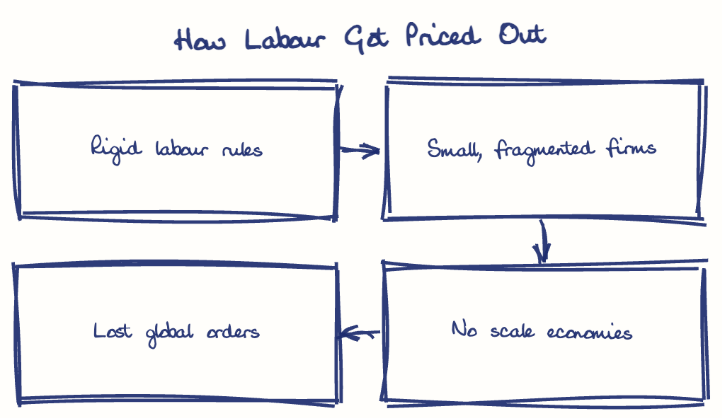
Rigid labour laws
Chapter V-B of the Industrial Disputes Act 1947 required permission to lay off workers in units of 100 or more, so firms chose machines or stayed small.
Missing middle
Decades of small-scale reservation for garments and footwear left firms too small to fill large global orders.
Distorted costs and access
Inverted duties made man-made fibre costlier than cotton, while Bangladesh enjoys duty-free EU entry that Indian apparel lacks.
Flexibility with security
Fixed-term employment and the Labour Codes, in force since November 2025, raise the lay-off threshold to 300 workers and widen social security.
Scale through clusters
PM MITRA parks, PLI for man-made fibre textiles and the Budget 2025-26 footwear and leather scheme build scale.
Market access
The India-UK trade agreement (July 2025) will give duty-free access for textiles and leather.
Costs and skills
GST 2.0 (September 2025) corrected the fibre inverted duty, and the Samarth scheme skills textile workers.
This model answer is indicative and the model can make mistakes; please verify key facts independently.
Practise this question
1Get the answer sheet
Sized for this question.
2Write your answer
Timed, by hand.
3Get it marked
Your score and what to fix.
This chapter in the exam
Industrial Growth4 questions
Asked in 3 of 14 sittings since 2013
- 2026How are startups in India promoting entrepreneurship, innovation and employment? Discuss the global and domestic challenges in their working and suggest suitable measures to overcome these challenges. (Answer in 250 words)
- 2023Faster economic growth requires increased share of the manufacturing sector in GDP, particularly of MSMEs. Comment on the present policies of the Government in this regard.
All 4 questions, sorted by sub-topic, with model answers and practice.
Question from the official UPSC Civil Services (Main) Examination 2017 paper. Answer written by Ghissu's engine and checked against our editorial standards. Found an error? Tell us and we correct it within 48 hours.