2023 · GS Paper 3 · Q1 · 10 marks
Faster economic growth requires increased share of the manufacturing sector in GDP, particularly of MSMEs. Comment on the present policies of the Government in this regard.
In short
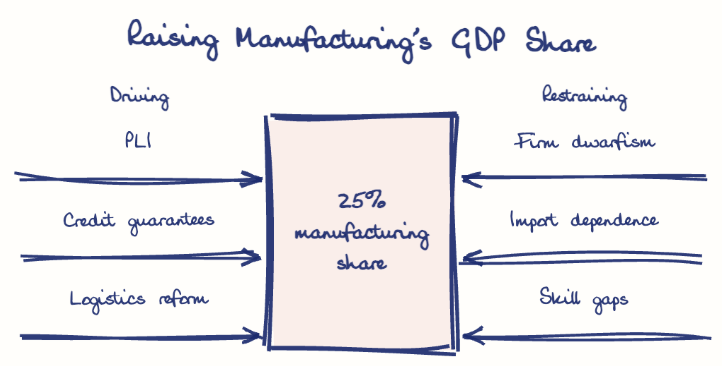
Present policies combine PLI scale incentives, MSME credit and payment reforms and logistics upgrades, but manufacturing's share stays low because most MSMEs remain micro and weakly linked to large firms. Manufacturing formed only 14.3% of GVA in FY23 against Make in India's 25% goal.
Model answer
Ghissu Editorial · Verified 4 Oct 2026 · 275 words
Scale through PLI
Incentives across 14 sectors took mobile phone exports from Rs 1,500 crore in 2014-15 to over Rs 2 lakh crore in 2024-25.
Credit and formalisation
The composite MSME definition of 2020, revised upward in Budget 2025-26, Udyam registration and CGTMSE guarantees widen formal credit without penalising growth.
Payments and markets
TReDS, the 45-day payment rule under Section 43B(h) and the 25% procurement mandate for small enterprises ease working capital.
Cheaper production
The 15% tax rate for new manufacturing units (2019), PM Gati Shakti and PM MITRA parks lower costs.
Missing middle
Most MSMEs are micro units that rarely graduate, so they cannot invest in technology or join global value chains.
Assembly over depth
PLI gains concentrate in large firms with high imported content, leaving MSME supplier linkages thin.
Skills deficit
Even with the Labour Codes easing compliance since November 2025, low skills cap productivity in small units.
This model answer is indicative and the model can make mistakes; please verify key facts independently.
Practise this question
1Get the answer sheet
Sized for this question.
2Write your answer
Timed, by hand.
3Get it marked
Your score and what to fix.
This chapter in the exam
Industrial Growth4 questions
Asked in 3 of 14 sittings since 2013
- 2026How are startups in India promoting entrepreneurship, innovation and employment? Discuss the global and domestic challenges in their working and suggest suitable measures to overcome these challenges. (Answer in 250 words)
- 2017Account for the failure of manufacturing sector in achieving the goal of labour-intensive exports. Suggest measures for more labour-intensive rather than capital-intensive exports.
All 4 questions, sorted by sub-topic, with model answers and practice.
Question from the official UPSC Civil Services (Main) Examination 2023 paper. Answer written by Ghissu's engine and checked against our editorial standards. Found an error? Tell us and we correct it within 48 hours.