2017 · GS Paper 3 · Q1 · 10 marks
Among several factors for India's potential growth, savings rate is the most effective one. Do you agree ? What are the other factors available for growth potential ?
In short
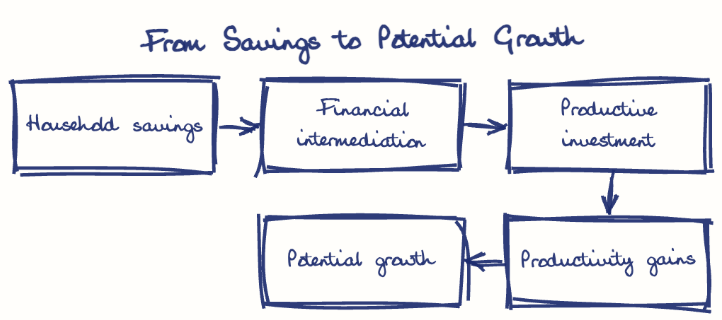
The savings rate is a necessary but not the most effective driver of India's potential growth, because capital without skills, technology and sound institutions meets diminishing returns. Savings near 37% of GDP in 2007-08 coincided with growth above 9%, yet about 84% of household wealth still sits in real estate and other physical goods.
Model answer
Ghissu Editorial · Verified 4 Oct 2026 · 296 words
Classical logic
In the Harrod-Domar model growth equals the savings rate divided by the capital-output ratio, so higher savings finance more investment.
Indian evidence
Gross domestic savings near 37% of GDP in 2007-08 coincided with three years of growth above 9%, and savings recovered to 34.2% of national disposable income in 2024-25 (RBI Annual Report).
Limits of volume
The RBI Household Finance Committee (2017) found 84% of household wealth in real estate and other physical goods and 11% in gold, and after 2011 high investment met stalled projects and slowing growth.
Labour and skills
A median age under 30 is an asset, but female participation of 41.7% (PLFS 2023-24) and youth employability of only about 51% (India Skills Report 2024) waste much of it.
Productivity and technology
Solow showed that long-run growth comes from total factor productivity, which research spending below 1% of GDP restrains and digital public infrastructure such as UPI lifts.
Infrastructure and institutions
PM Gati Shakti (2021), the Insolvency and Bankruptcy Code (2016) and GST (2017) lower the logistics and transaction costs that deter private investment.
This model answer is indicative and the model can make mistakes; please verify key facts independently.
Practise this question
1Get the answer sheet
Sized for this question.
2Write your answer
Timed, by hand.
3Get it marked
Your score and what to fix.
This chapter in the exam
Growth8 questions
Asked in 6 of 14 sittings since 2013
- 2024Discuss the merits and demerits of the four 'Labour Codes' in the context of labour market reforms in India. What has been the progress so far in this regard?
- 2024What are the causes of persistent high food inflation in India? Comment on the effectiveness of the monetary policy of the RBI to control this type of inflation.
All 8 questions, sorted by sub-topic, with model answers and practice.
Question from the official UPSC Civil Services (Main) Examination 2017 paper. Answer written by Ghissu's engine and checked against our editorial standards. Found an error? Tell us and we correct it within 48 hours.