2017 · GS Paper 3 · Q17 · 15 marks
Climate change' is a global problem. How India will be affected by climate change ? How Himalayan and coastal states of India will be affected by climate change ?
In short
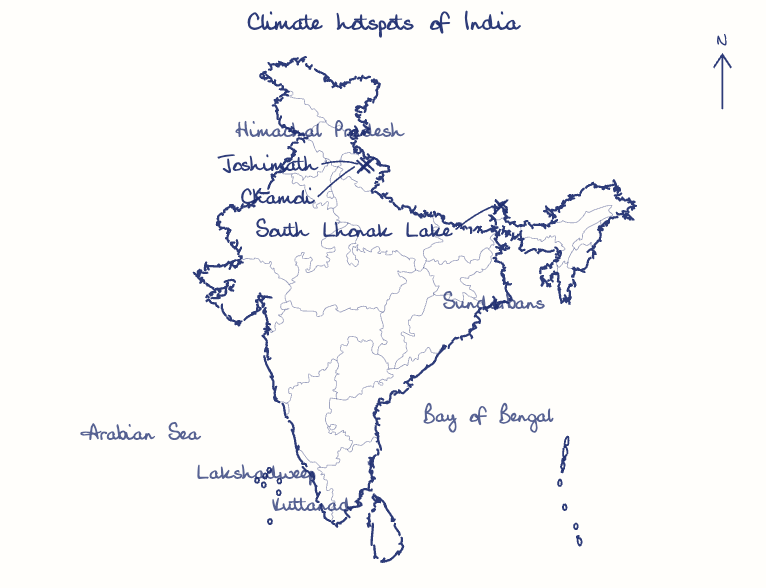
Climate change hits India through falling farm yields, water stress, deadlier heatwaves and disaster displacement, with the Himalayan states facing glacial lake bursts and landslides and the coastal states facing erosion, sea-level rise and stronger cyclones. The South Lhonak GLOF in Sikkim (2023) breached the Teesta-III dam.
Model answer
Ghissu Editorial · Verified 4 Oct 2026 · 299 words
Agriculture
ICAR's NICRA projects rainfed rice yields falling about 20% by 2050; the March 2022 heatwave hit wheat in Punjab and Haryana.
Water and health
Retreating glaciers destabilise the Ganga and Brahmaputra systems, while heatwaves and spreading dengue and malaria hurt outdoor workers.
Displacement
About 5.4 million Indians were displaced by disasters in 2024, including the Assam floods (IDMC, 2025).
Himalayan hazards
The South Lhonak GLOF in Sikkim (2023) breached the Teesta-III dam, and Chamoli (2021) and Himachal's 2023 floods show cloudbursts and landslides intensifying.
Hill livelihoods
Apple orchards are moving uphill in Himachal and nearly half of perennial springs are drying (NITI Aayog, 2018).
Coastal inundation
Islands such as Ghoramara in the Sundarbans are shrinking, and about a third of the mainland coast eroded between 1990 and 2018 (NCCR).
Cyclones and seas
Amphan (2020) and Tauktae (2021) show stronger storms on both coasts, while corals bleach in Lakshadweep.
Targeted resilience
Monitor glacial lakes under NDMA's GLOF programme, restore mangroves under MISHTI and spread heat action plans like Ahmedabad's (2013).
This model answer is indicative and the model can make mistakes; please verify key facts independently.
Practise this question
1Get the answer sheet
Sized for this question.
2Write your answer
Timed, by hand.
3Get it marked
Your score and what to fix.
This chapter in the exam
Conservation19 questions
Asked in 11 of 14 sittings since 2013
- 2026Discuss the aim and goals of Kunming-Montreal global biodiversity framework. Mention India's commitments and initiatives to achieve the goals and targets of this framework giving suitable examples. (Answer in 150 words)
- 2025What is Carbon Capture, Utilization and Storage (CCUS) ? What is the potential role of CCUS in tackling climate change ?
All 19 questions, sorted by sub-topic, with model answers and practice.
Question from the official UPSC Civil Services (Main) Examination 2017 paper. Answer written by Ghissu's engine and checked against our editorial standards. Found an error? Tell us and we correct it within 48 hours.