2017 · GS Paper 3 · Q12 · 15 marks
"Industrial growth rate has lagged behind in the overall growth of Gross-Domestic-Product (GDP) in the post-reform period." Give reasons. How far the recent changes in Industrial-Policy are capable of increasing the industrial growth rate ?
In short
Industry lagged GDP because growth leapfrogged to services while labour, land, infrastructure and twin balance sheet constraints held factories back. Recent reforms such as GST, IBC, the 2019 tax cut and PLI lifted industrial growth to 9.5% in FY24, but only partially fix scale and value addition.
Model answer
Ghissu Editorial · Verified 4 Oct 2026 · 286 words
Services leapfrogging
Skilled, English-speaking labour let IT services grow with little capital, while factories faced costly land, power and labour.
Factor-market rigidities
Chapter V-B of the Industrial Disputes Act 1947 and slow land acquisition kept firms small.
Twin balance sheet problem
Stressed corporates and NPA-laden banks, flagged in the Economic Survey 2016-17, choked industrial credit.
Import competition
Cheap Chinese goods and inverted duties under FTAs undercut domestic components.
Market and credit repair
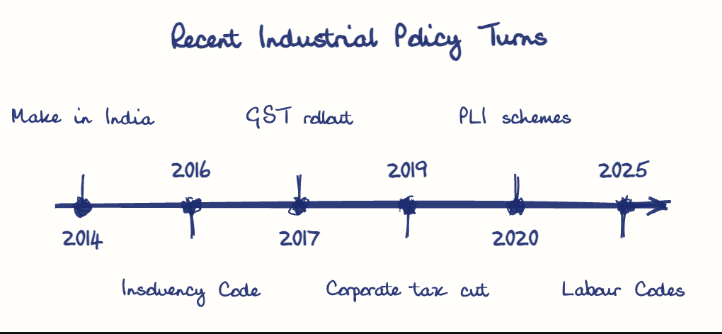
GST unified the market and the IBC disciplined borrowers, reviving credit.
Investment incentives
The 15% tax rate for new factories and PLI in 14 sectors helped industry grow 9.5% in FY24.
Limits
Gains sit in large, import-heavy assembly firms, job creation lags output, and manufacturing's share has not yet risen decisively.
Deepen value chains
Shift PLI from assembly towards components, with MSME supplier development.
Factor reforms
Operationalise the Labour Codes and build land banks with single-window clearance.
This model answer is indicative and the model can make mistakes; please verify key facts independently.
Practise this question
1Get the answer sheet
Sized for this question.
2Write your answer
Timed, by hand.
3Get it marked
Your score and what to fix.
This chapter in the exam
Industrial Growth4 questions
Asked in 3 of 14 sittings since 2013
- 2026How are startups in India promoting entrepreneurship, innovation and employment? Discuss the global and domestic challenges in their working and suggest suitable measures to overcome these challenges. (Answer in 250 words)
- 2023Faster economic growth requires increased share of the manufacturing sector in GDP, particularly of MSMEs. Comment on the present policies of the Government in this regard.
All 4 questions, sorted by sub-topic, with model answers and practice.
Question from the official UPSC Civil Services (Main) Examination 2017 paper. Answer written by Ghissu's engine and checked against our editorial standards. Found an error? Tell us and we correct it within 48 hours.