2017 · GS Paper 3 · Q14 · 15 marks
What are the major reasons for declining rice and wheat yield in the cropping system ? How crop diversification is helpful to stabilise the yield of the crops in the system ?
In short
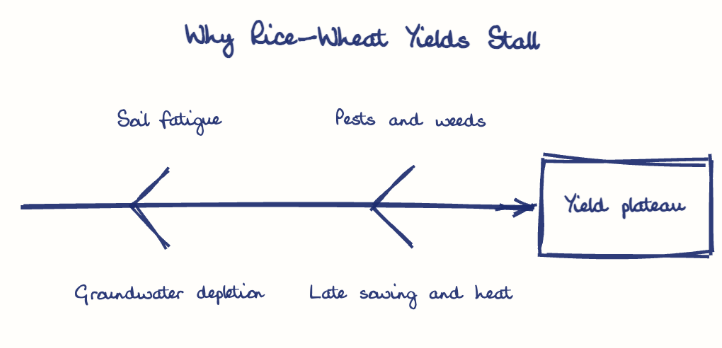
Rice and wheat yields in the Indo-Gangetic heartland have plateaued because of soil fatigue, groundwater depletion, resistant weeds and pests, late sowing and heat stress. Diversification with legumes, maize and millets restores soil nitrogen, breaks pest cycles, saves water and spreads climate risk.
Model answer
Ghissu Editorial · Verified 4 Oct 2026 · 284 words
Soil fatigue
Puddling and residue removal have depleted soil organic carbon, created a hardpan and caused zinc and sulphur deficiencies, while urea-heavy use skews the nutrient ratio.
Groundwater depletion
Paddy has pushed Punjab's groundwater extraction above recharge in CGWB assessments, raising pumping costs.
Pests and weeds
Monoculture bred isoproturon-resistant Phalaris minor and allowed the 2022 dwarf virus outbreak in paddy.
Late sowing and heat
Delayed paddy transplanting under Punjab's 2009 subsoil water law pushes wheat late, and the March 2022 heatwave shrivelled grain.
Biological nitrogen
A summer moong or berseem break fixes nitrogen and raises the following cereal's yield.
Breaking pest cycles
Rotation with berseem or potato disrupts Phalaris minor.
Saving water
Haryana's Mera Pani Meri Virasat (2020) pays farmers to shift paddy to maize, cotton or pulses.
Spreading risk
Millets, pulses and livestock cushion farmers against single heat or rain shocks.
Crop-neutral support
Extend assured procurement to pulses, maize and millets, as the Johl Committee urged when it advised shifting a fifth of Punjab's rice-wheat area.
Soil and seed
Scale direct-seeded rice, Happy Seeder sowing and Soil Health Card advice, and spread ICAR's heat-tolerant wheat varieties.
This model answer is indicative and the model can make mistakes; please verify key facts independently.
Practise this question
1Get the answer sheet
Sized for this question.
2Write your answer
Timed, by hand.
3Get it marked
Your score and what to fix.
This chapter in the exam
Major Crops and Cropping Patterns10 questions
Asked in 10 of 14 sittings since 2013
- 2026How Indian agriculture has been transformed from food scarcity to food surplus level? Explain the various government policies implemented for diversification of Indian agriculture. (Answer in 250 words)
- 2025Explain the factors influencing the decision of the farmers on the selection of high value crops in India.
All 10 questions, sorted by sub-topic, with model answers and practice.
Question from the official UPSC Civil Services (Main) Examination 2017 paper. Answer written by Ghissu's engine and checked against our editorial standards. Found an error? Tell us and we correct it within 48 hours.