2017 · GS Paper 4 · Q8(a) · 10 marks
Discipline generally implies following the order and subordination. However, it may be counter-productive for the organisation. Discuss.
In short
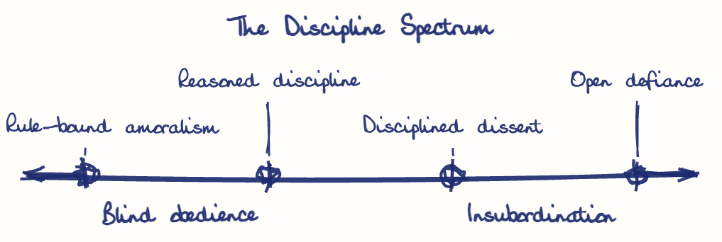
Discipline enables coordination and accountability, but blind obedience can defeat an organisation's purpose through goal displacement, groupthink and complicity in wrong orders. The Shah Commission (1978) found officials executing illegal orders during the Emergency.
Model answer
Ghissu Editorial · Verified 4 Oct 2026 · 278 words
Coordination at scale
The Election Commission ran the 2024 general election for nearly 97 crore voters because lakhs of polling staff followed one manual and one chain of command.
Clear accountability
The CCS (Conduct) Rules, 1964 and CCS (CCA) Rules, 1965 fix who answers for what, Article 311 shields officers from arbitrary punishment, and disciplined coordination in the Silkyara tunnel rescue (2023) saved all 41 trapped workers.
Rule-bound amoralism
Refusing a dying patient admission for want of one document obeys the rule and defeats the hospital's purpose.
Silenced expertise
Strict subordination breeds groupthink; managers overrode engineers' O-ring warnings before the Challenger disaster of 1986.
Complicity in wrong orders
About two-thirds of subjects in Milgram's experiments (1963) gave the maximum shock on instruction, and the Shah Commission (1978) found officials obeying illegal Emergency orders.
Fear over initiative
Rewarding obedience pushes decisions up the file, which is why T.S.R. Subramanian v Union of India (2013) asked officers to record oral instructions.
This model answer is indicative and the model can make mistakes; please verify key facts independently.
Practise this question
1Get the answer sheet
Sized for this question.
2Write your answer
Timed, by hand.
3Get it marked
Your score and what to fix.
This chapter in the exam
Public/Civil service values and Ethics in Public Administration — Status and problems5 questions
Asked in 5 of 14 sittings since 2013
- 2026Efficiency is doing things right, while effectiveness is doing the right thing. How do you strike a balance between the two to enhance productivity?
- 2025To achieve holistic development goal, a civil servant acts as an enabler and active facilitator of growth rather than a regulator. What specific measures will you suggest to achieve this goal?
All 5 questions, sorted by sub-topic, with model answers and practice.
Question from the official UPSC Civil Services (Main) Examination 2017 paper. Answer written by Ghissu's engine and checked against our editorial standards. Found an error? Tell us and we correct it within 48 hours.