2017 · GS Paper 4 · Q2(b) · 2 marks
Examine the relevance of the following in the context of civil service: Accountability
In short
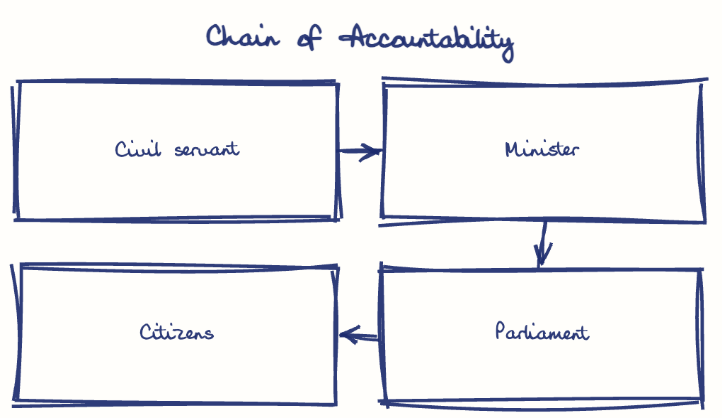
Accountability gives an unelected civil service its legitimacy by linking every decision to ministers, Parliament and citizens, and by checking misuse of discretion. Section 17A of the Prevention of Corruption Act, added in 2018, shows it must be balanced with protection for bona fide decisions.
Model answer
Ghissu Editorial · Verified 4 Oct 2026 · 259 words
Democratic chain
Under Article 75(3) ministers answer to the Lok Sabha and civil servants answer to ministers, linking every file noting to the voter.
Checking corruption
The Prevention of Corruption Act, 1988 (amended 2018), the CVC and the Lokpal under the 2013 Act act as legal sanctions on misuse of discretion.
Citizen-centric delivery
Proactive disclosure under Section 4 of the RTI Act, 2005, citizen's charters and CPGRAMS let citizens hold a named office to a standard.
Citizens as auditors
MGNREGA social audits under Section 17, pioneered by Andhra Pradesh's SSAAT, let the Gram Sabha verify wages and works directly, the strongest form of downward accountability.
Answerable, not fearful
Fear of the "four Cs" breeds policy paralysis, so Section 17A (2018) requires prior approval before probing bona fide decisions; T.S.R. Subramanian (2013) asked officers to record oral instructions.
Moral sanction
Legal sanction works from outside, but self-accountability to one's conscience, as Gandhi's talisman asks, holds even where no audit reaches.
This model answer is indicative and the model can make mistakes; please verify key facts independently.
Practise this question
1Get the answer sheet
Sized for this question.
2Write your answer
Timed, by hand.
3Get it marked
Your score and what to fix.
This chapter in the exam
Accountability and ethical governance7 questions
Asked in 6 of 14 sittings since 2013
- 2025"Constitutional morality is not a natural sentiment but a product of civil education and adherence of the rule of law." Examine the significance of constitutional morality for public servant highlighting the role in promoting good governance and ensuring accountability in public administration.
- 2022What do you understand by the term 'good governance'? How far recent initiatives in terms of e-Governance steps taken by the State have helped the beneficiaries? Discuss with suitable examples.
All 7 questions, sorted by sub-topic, with model answers and practice.
Question from the official UPSC Civil Services (Main) Examination 2017 paper. Answer written by Ghissu's engine and checked against our editorial standards. Found an error? Tell us and we correct it within 48 hours.