2018 · GS Paper 1 · Q2 · 10 marks
Assess the importance of the accounts of the Chinese and Arab travellers in the reconstruction of the history of India.
In short
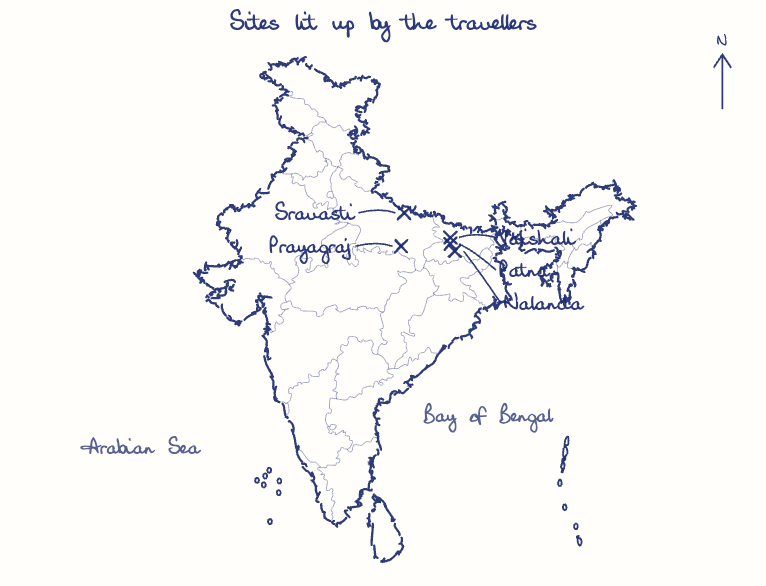
Chinese and Arab travellers' accounts are vital for dating rulers, describing society and economy, and locating lost sites, though their religious focus, patronage and reliance on informants demand corroboration. Alexander Cunningham followed Xuanzang's itinerary to identify Buddhist sites such as Sravasti and Sankisa.
Model answer
Ghissu Editorial · Verified 4 Oct 2026 · 282 words
Chronology and polity
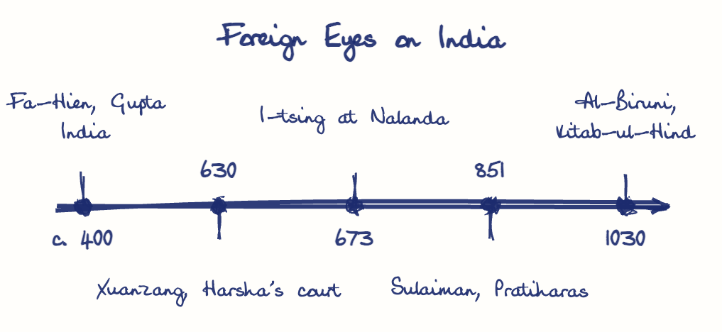
Xuanzang's Si-Yu-Ki describes Harsha's assembly at Kanauj and his gifts at Prayag, adding dates and detail that Banabhatta's Harshacharita alone could not.
Society and economy
Fa-Hien records Chandalas living outside towns and striking wood to announce themselves, and Xuanzang's deserted Pataliputra supports R.S. Sharma's thesis of urban decline.
Archaeology and Arab views
Alexander Cunningham followed Xuanzang's route to identify Sravasti and Sankisa, while Sulaiman ranked the Rashtrakuta king among the world's four great rulers and Al-Biruni analysed caste and Sanskrit science.
Monastic learning
I-tsing's decade at Nalanda describes the curriculum and discipline that its excavated ruins cannot reveal.
Religious lens
Fa-Hien never names Chandragupta II, as his gaze stayed on monasteries.
Patronage and contradiction
R.C. Majumdar cautions that Xuanzang inflated Harsha's greatness, and Fa-Hien's safe roads sit uneasily with Xuanzang being robbed on the Ganga.
Textual filter
Al-Biruni relied on Sanskrit texts and Brahmin informants, describing norms more than practice.
This model answer is indicative and the model can make mistakes; please verify key facts independently.
Practise this question
1Get the answer sheet
Sized for this question.
2Write your answer
Timed, by hand.
3Get it marked
Your score and what to fix.
This chapter in the exam
Indian Culture - Ancient Times8 questions
Asked in 6 of 14 sittings since 2013
- 2026Analyze the importance of Ashokan inscriptions for reconstructing Mauryan history.
- 2024Underline the changes in the field of society and economy from the Rig Vedic to the later Vedic period.
All 8 questions, sorted by sub-topic, with model answers and practice.
Question from the official UPSC Civil Services (Main) Examination 2018 paper. Answer written by Ghissu's engine and checked against our editorial standards. Found an error? Tell us and we correct it within 48 hours.