2018 · GS Paper 1 · Q10 · 10 marks
How the Indian concept of secularism is different from the western model of secularism ? Discuss.
In short
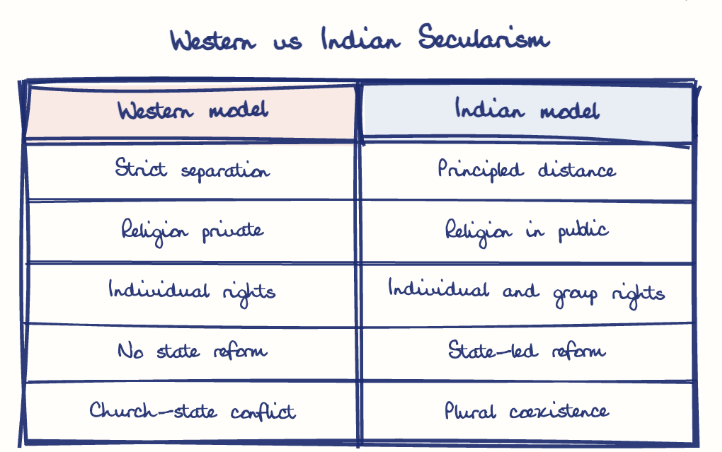
Western secularism rests on a strict wall of separation that keeps religion private, while Indian secularism follows principled distance, equal respect for all faiths and state-led reform. India protects group rights under Articles 29-30 and reformed faith through Article 17 and temple entry under Article 25(2)(b).
Model answer
Ghissu Editorial · Verified 4 Oct 2026 · 296 words
Separation versus distance
France's 2004 ban on conspicuous religious symbols in public schools keeps faith out of state spaces, while India aids minority institutions under Article 30(2).
Public expression
Article 25 protects professing, practising and propagating religion, and the state marks festivals of every faith as holidays.
Group rights
India protects communities through Articles 29 and 30 and separate personal laws, not only individual believers.
State-led reform
Article 17 abolished untouchability and Article 25(2)(b) opened Hindu temples to all castes.
Historical roots
Western secularism grew out of church-crown conflict; India's grew from coexistence, from Ashoka's Edict XII to Akbar's Sulh-i-kul.
Contextual secularism
Rajeev Bhargava's "principled distance" lets the state engage with or keep away from religion as equality requires.
Strains
The 1986 Act reversing Shah Bano fed the charge of selective intervention, and the Uniform Civil Code debate under Article 44 continues.
Western variety
The West is not uniform either: Britain keeps an established Church of England, while the United States tolerates public religiosity.
This model answer is indicative and the model can make mistakes; please verify key facts independently.
Practise this question
1Get the answer sheet
Sized for this question.
2Write your answer
Timed, by hand.
3Get it marked
Your score and what to fix.
This chapter in the exam
Secularism4 questions
Asked in 4 of 14 sittings since 2013
- 2022Are tolerance, assimilation and pluralism the key elements in the making of an Indian form of secularism ? Justify your answer.
- 2019What are the challenges to our cultural practices in the name of secularism ?
All 4 questions, sorted by sub-topic, with model answers and practice.
Question from the official UPSC Civil Services (Main) Examination 2018 paper. Answer written by Ghissu's engine and checked against our editorial standards. Found an error? Tell us and we correct it within 48 hours.