2019 · GS Paper 1 · Q10 · 10 marks
What are the challenges to our cultural practices in the name of secularism ?
In short
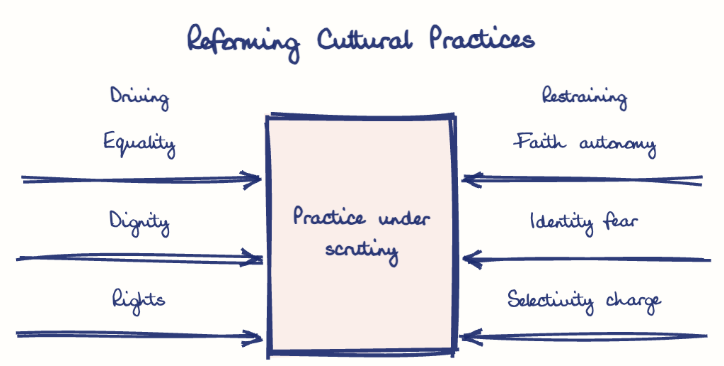
Secularism challenges Indian cultural practices when courts and the state test them against equality, as in Sabarimala (2018) and Shayara Bano (2017), and when selective application breeds resentment. The essential practices test begun in Shirur Mutt (1954) lets judges decide which rituals are core to a faith.
Model answer
Ghissu Editorial · Verified 4 Oct 2026 · 269 words
Courts judging theology
Since Shirur Mutt (1954) courts decide which practices are "essential"; Sabarimala (2018) admitted women of all ages, drawing protests by devotees, and the review went to a larger bench in 2019.
Personal law and gender
Shayara Bano (2017) ended instant triple talaq, which some in the community read as the state rewriting faith.
Neutrality of public spaces
The Kendriya Vidyalaya prayer petition (referred in 2019) and the Karnataka hijab split verdict (2022) asked whether religious-cultural expression belongs in state institutions.
Charge of selectivity
The 1986 Act that undid Shah Bano (1985) fed the "pseudo-secularism" charge, so reform of majority practices is resented as one-sided.
Alien idiom
T.N. Madan (1987) and Ashis Nandy argued that an imported, rationalist secularism alienates a religious people and pushes faith towards communal politics.
Shared practices squeezed
Sorting culture into rigid religious boxes weakens syncretic traditions such as the Bhakti-Sufi legacy of Kabir, as communal claims over festivals and shrines grow.
This model answer is indicative and the model can make mistakes; please verify key facts independently.
Practise this question
1Get the answer sheet
Sized for this question.
2Write your answer
Timed, by hand.
3Get it marked
Your score and what to fix.
This chapter in the exam
Secularism4 questions
Asked in 4 of 14 sittings since 2013
- 2022Are tolerance, assimilation and pluralism the key elements in the making of an Indian form of secularism ? Justify your answer.
- 2018How the Indian concept of secularism is different from the western model of secularism ? Discuss.
All 4 questions, sorted by sub-topic, with model answers and practice.
Question from the official UPSC Civil Services (Main) Examination 2019 paper. Answer written by Ghissu's engine and checked against our editorial standards. Found an error? Tell us and we correct it within 48 hours.