2022 · GS Paper 1 · Q19 · 15 marks
Are tolerance, assimilation and pluralism the key elements in the making of an Indian form of secularism ? Justify your answer.
In short
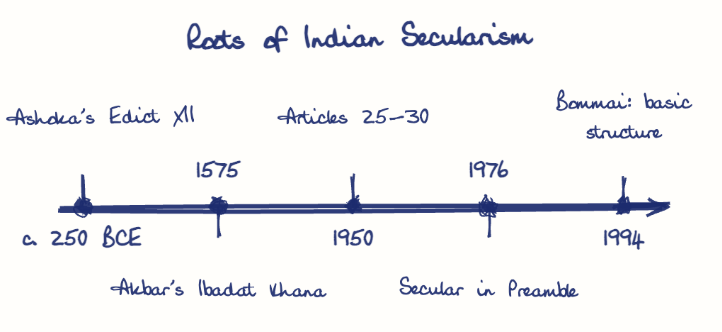
Tolerance, assimilation and pluralism are the civilisational bedrock of Indian secularism, but its constitutional form also needs principled distance, equal citizenship and judicial enforcement. S.R. Bommai (1994) made secularism a basic feature, while Article 17 and Shayara Bano (2017) show the state reforming religion.
Model answer
Ghissu Editorial · Verified 4 Oct 2026 · 305 words
Tolerance
Gandhi's sarva dharma sambhava and Vivekananda's 1893 call to accept, not merely tolerate, all faiths made coexistence a public creed.
Assimilation
The Bhakti-Sufi synthesis of Kabir and Guru Nanak and Akbar's Sulh-i-kul created the composite Ganga-Jamuni culture.
Pluralism
Articles 29 and 30 and separate personal laws let communities keep their identity instead of dissolving it.
Principled distance
The state also reforms religion, through Article 17, temple entry under Article 25(2)(b) and Shayara Bano (2017) on instant triple talaq.
Equal citizenship
Articles 14 to 16 guarantee equality as a right, which tolerance, often condescending, cannot.
Judicial teeth
S.R. Bommai (1994) made secularism a basic feature of the Constitution and upheld the dismissal of governments that failed to protect it.
Limits of assimilation
Read as absorption into a majority idiom, assimilation can erase minority identity rather than accommodate it.
Rule of law
Enforce the Tehseen Poonawalla (2018) guidelines against mob lynching whatever the offender's faith.
Reform by consensus
Reform personal laws through dialogue, as the 21st Law Commission (2018) advised.
This model answer is indicative and the model can make mistakes; please verify key facts independently.
Practise this question
1Get the answer sheet
Sized for this question.
2Write your answer
Timed, by hand.
3Get it marked
Your score and what to fix.
This chapter in the exam
Secularism4 questions
Asked in 4 of 14 sittings since 2013
- 2019What are the challenges to our cultural practices in the name of secularism ?
- 2018How the Indian concept of secularism is different from the western model of secularism ? Discuss.
All 4 questions, sorted by sub-topic, with model answers and practice.
Question from the official UPSC Civil Services (Main) Examination 2022 paper. Answer written by Ghissu's engine and checked against our editorial standards. Found an error? Tell us and we correct it within 48 hours.