2018 · GS Paper 1 · Q17 · 15 marks
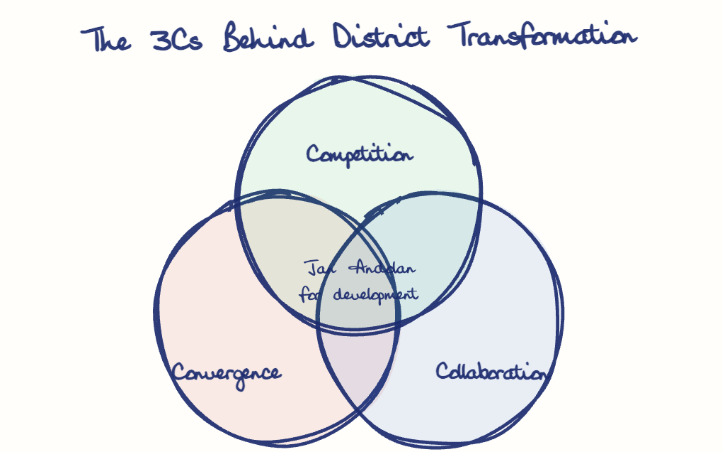
Mention core strategies for the transformation of aspirational districts in India and explain the nature of convergence, collaboration and competition for its success.
In short
The Aspirational Districts Programme transforms India's 112 most backward districts through weighted themes, real-time KPIs and local strengths, driven by convergence of schemes, collaboration across government levels and partners, and competition through monthly delta rankings. Districts are tracked on 49 indicators on the Champions of Change dashboard.
Model answer
Ghissu Editorial · Verified 4 Oct 2026 · 272 words
Weighted themes
Health and Nutrition and Education (30% each), Agriculture and Water (20%), and Financial Inclusion and Skills and Basic Infrastructure (10% each).
Data-driven governance
49 KPIs are tracked in near real time on the Champions of Change dashboard.
Local strengths
Districts target low-hanging fruit and their own advantage, as Chandauli did with black rice exports, with states and collectors as the main drivers.
Convergence
Schemes such as Poshan Abhiyaan, Samagra Shiksha and Jal Jeevan Mission are dovetailed at district level to serve the same indicators.
Collaboration
A Central Prabhari Officer, a state nodal officer and the collector work as one team, with partners such as Piramal Foundation and Tata Trusts.
Competition
Monthly delta rankings reward improvement, not absolute level, creating a race to the top among peers.
Data and tenure
Verify self-reported KPIs independently and assure collectors stable tenures.
Deeper reach
Take the 3Cs to the 500 blocks of the Aspirational Blocks Programme (2023).
This model answer is indicative and the model can make mistakes; please verify key facts independently.
Practise this question
1Get the answer sheet
Sized for this question.
2Write your answer
Timed, by hand.
3Get it marked
Your score and what to fix.
This chapter in the exam
Poverty and developmental issues9 questions
Asked in 6 of 14 sittings since 2013
- 2025Achieving sustainable growth with emphasis on environmental protection could come into conflict with poor people's needs in a country like India - Comment.
- 2025How does smart city in India, address the issues of urban poverty and distributive justice ?
All 9 questions, sorted by sub-topic, with model answers and practice.
Question from the official UPSC Civil Services (Main) Examination 2018 paper. Answer written by Ghissu's engine and checked against our editorial standards. Found an error? Tell us and we correct it within 48 hours.