2018 · GS Paper 1 · Q7 · 10 marks
What are the consequences of spreading of 'Dead Zones' on marine ecosystem?
In short
Spreading dead zones suffocate bottom life, squeeze fish into thin oxygenated layers, hand food webs to jellyfish and microbes, and release nitrous oxide and hydrogen sulphide. The IUCN (2019) counted about 700 low-oxygen ocean sites, against only 45 in the 1960s.
Model answer
Ghissu Editorial · Verified 4 Oct 2026 · 272 words
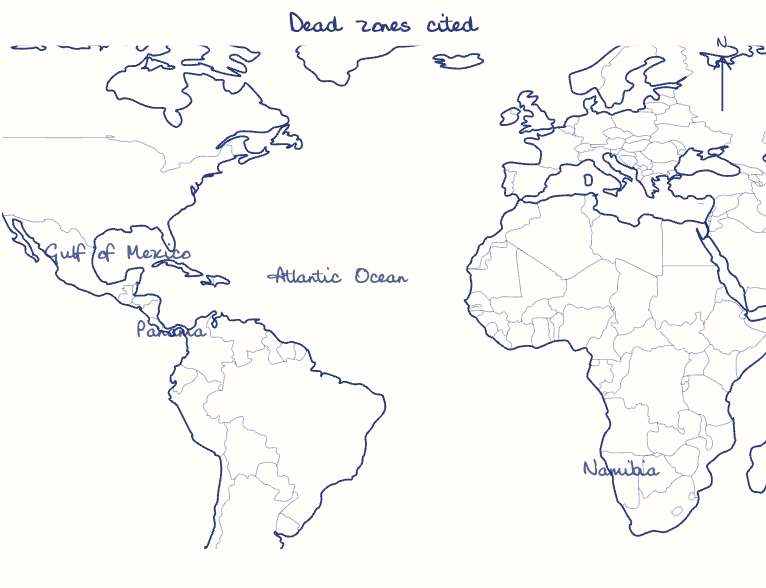
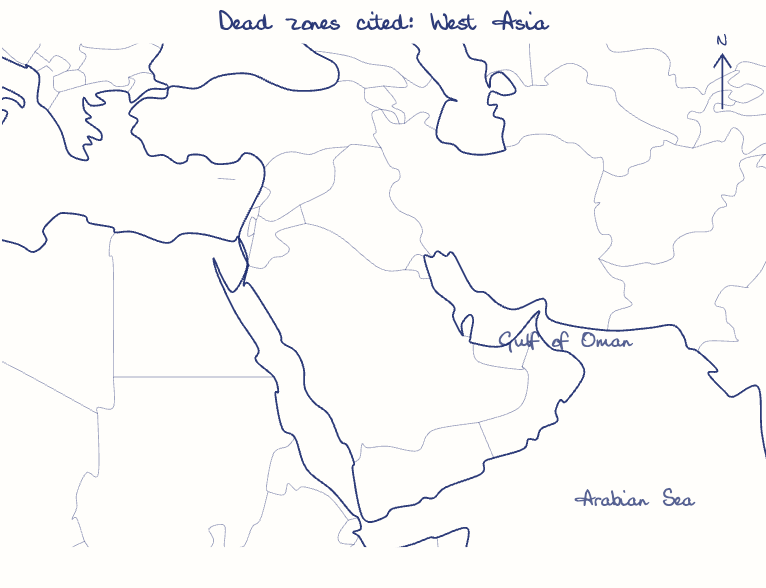
Dead zones are hypoxic waters with dissolved oxygen below about 2 mg per litre, formed when nutrient-fed algal blooms decay, a process warming worsens. The IUCN (2019) counted about 700 low-oxygen ocean sites against 45 in the 1960s, and the Gulf of Oman dead zone was found larger than Scotland in 2018.
Consequences for Marine Life and Food Webs
Dead Zone Cascade → Oxygen below 2 mg/L → Bottom fauna die → Fish flee and crowd → Jellyfish, microbes dominate → N2O, H2S released
1. Mass mortality of bottom life: Clams, worms and crabs cannot escape and suffocate, as each summer in the Gulf of Mexico. 2. Habitat compression: Fish crowd into thin oxygenated layers; tuna and billfish in the eastern tropical Atlantic have been squeezed towards the surface. 3. Simplified food webs: Hypoxia-tolerant jellyfish and microbes replace fish and crustaceans, while chronic low oxygen stunts breeding, as in Gulf of Mexico croaker.
Altered nutrient cycles
Low-oxygen waters release nitrous oxide, a potent greenhouse gas; Naqvi and colleagues (Nature, 2000) linked rising emissions to seasonal anoxia on India's western shelf.
Toxic events and reef loss
Hydrogen sulphide eruptions off Namibia kill fish, and a 2010 hypoxic event at Bocas del Toro, Panama, killed corals.
Fisheries strain
Crowded fish are easier to overfish, and dead zones have shifted shrimp sizes and prices in the Gulf of Mexico.
This model answer is indicative and the model can make mistakes; please verify key facts independently.
Practise this question
1Get the answer sheet
Sized for this question.
2Write your answer
Timed, by hand.
3Get it marked
Your score and what to fix.
This chapter in the exam
Water (Oceans)4 questions
Asked in 4 of 14 sittings since 2013
- 2025What are Tsunamis? How and where are they formed? What are their consequences? Explain with examples.
- 2024What is sea surface temperature rise? How does it affect the formation of tropical cyclones?
All 4 questions, sorted by sub-topic, with model answers and practice.
Question from the official UPSC Civil Services (Main) Examination 2018 paper. Answer written by Ghissu's engine and checked against our editorial standards. Found an error? Tell us and we correct it within 48 hours.