2024 · GS Paper 1 · Q4 · 10 marks
What is sea surface temperature rise? How does it affect the formation of tropical cyclones?
In short
Sea surface temperature rise warms the ocean layer that fuels tropical cyclones, so storms form over wider areas, intensify faster and carry more rain, rather than simply growing more numerous. Arabian Sea cyclones rose 52% in 2001-2019 over 1982-2000, as a Climate Dynamics study (2021) found.
Model answer
Ghissu Editorial · Verified 4 Oct 2026 · 276 words
Temperature threshold
Cyclones need seas warmer than about 26.5°C to roughly 50 m depth, plus Coriolis force, low wind shear and a prior disturbance.
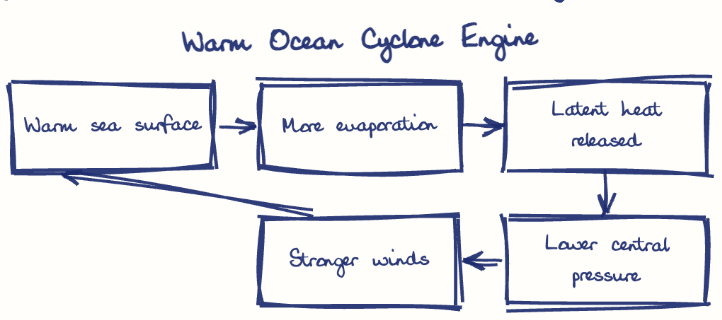
Heat engine
Evaporation feeds latent heat into the storm, deepening the low and speeding winds that draw up more moisture.
Wider breeding ground
Warmer seas cross the threshold over larger areas and for longer, lengthening cyclone seasons.
Rapid intensification
Amphan (2020) went from cyclonic storm to super cyclonic storm in under two days over a very warm Bay of Bengal.
Arabian Sea shift
A Climate Dynamics study (2021) found Arabian Sea cyclones rose 52%, and very severe ones 150%, in 2001-2019 over 1982-2000; Biparjoy (2023) lasted about 13 days.
Wetter, more intense storms
Air holds about 7% more moisture per 1°C, so rain is heavier; the IPCC sees no clear rise in cyclone numbers but a likely higher share of intense ones.
This model answer is indicative and the model can make mistakes; please verify key facts independently.
Practise this question
1Get the answer sheet
Sized for this question.
2Write your answer
Timed, by hand.
3Get it marked
Your score and what to fix.
This chapter in the exam
Water (Oceans)4 questions
Asked in 4 of 14 sittings since 2013
- 2025What are Tsunamis? How and where are they formed? What are their consequences? Explain with examples.
- 2019Assess the impact of global warming on the coral life system with examples.
All 4 questions, sorted by sub-topic, with model answers and practice.
Question from the official UPSC Civil Services (Main) Examination 2024 paper. Answer written by Ghissu's engine and checked against our editorial standards. Found an error? Tell us and we correct it within 48 hours.