2018 · GS Paper 2 · Q7 · 10 marks
Appropriate local community-level healthcare intervention is a prerequisite to achieve 'Health for All' in India. Explain.
In short
Community-level care is a prerequisite for Health for All because prevention, early detection and trusted last-mile access happen close to home, and they cut costs before illness reaches hospitals. ASHA-led institutional deliveries helped India's maternal mortality ratio fall from 130 in 2014-16 to 97 in 2018-20.
Model answer
Ghissu Editorial · Verified 4 Oct 2026 · 273 words
Prevention at source
Water, sanitation, nutrition and immunisation are community actions, planned by Village Health Sanitation and Nutrition Committees under the National Health Mission.
Access and trust
Around ten lakh ASHAs, given the WHO Global Health Leaders Award in 2022, reach households distant facilities cannot.
Early detection and lower costs
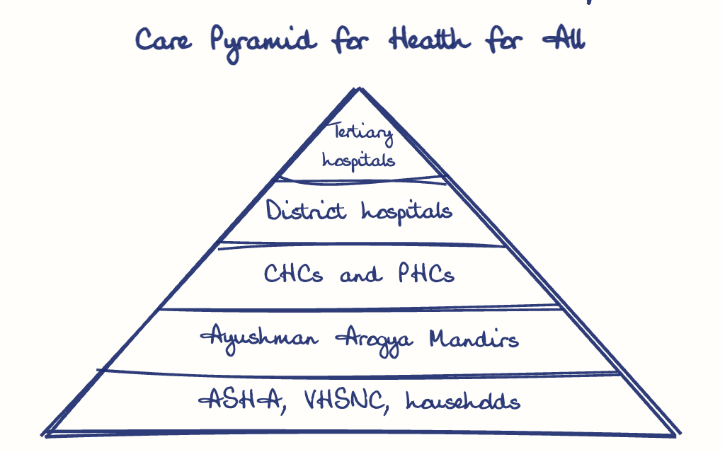
Ayushman Arogya Mandirs screen for hypertension, diabetes and cancers, and out-of-pocket spending fell from 64.2% of health expenditure in 2013-14 to 39.4% in 2021-22.
Newborn survival
SEARCH's home-based newborn care in Gadchiroli, run by Abhay and Rani Bang, sharply cut neonatal deaths and became the national model.
Maternal care
ASHA-led institutional deliveries under Janani Suraksha Yojana helped the maternal mortality ratio fall from 130 (2014-16) to 97 (2018-20).
Local fit
Odisha's DAMaN programme took malaria testing and treatment to remote forest villages, and Kerala's rapid local surveillance and contact tracing contained the 2018 Nipah outbreak.
This model answer is indicative and the model can make mistakes; please verify key facts independently.
Practise this question
1Get the answer sheet
Sized for this question.
2Write your answer
Timed, by hand.
3Get it marked
Your score and what to fix.
This chapter in the exam
Education9 questions
Asked in 8 of 14 sittings since 2013
- 2026Should education be treated primarily as a welfare obligation of the state or as a strategic investment for building a globally competitive, knowledge-driven nation ? Critically evaluate.
- 2023Skill development programmes have succeeded in increasing human resources supply to various sectors. In the context of the statement analyse the linkages between education, skill and employment.
All 9 questions, sorted by sub-topic, with model answers and practice.
Question from the official UPSC Civil Services (Main) Examination 2018 paper. Answer written by Ghissu's engine and checked against our editorial standards. Found an error? Tell us and we correct it within 48 hours.