2018 · GS Paper 3 · Q18 · 15 marks
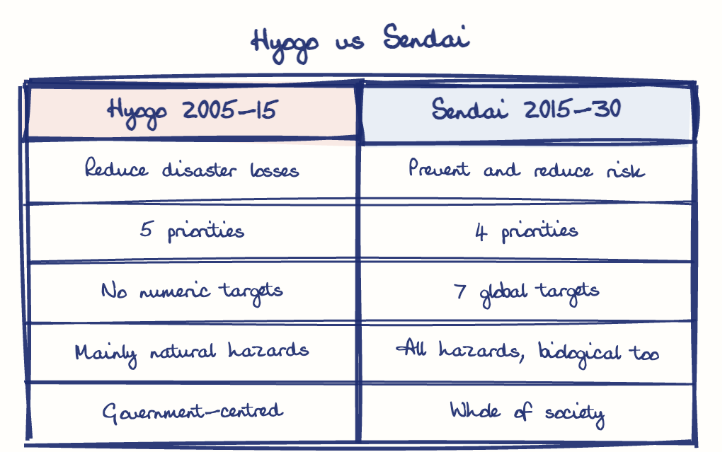
Describe various measures taken in India for Disaster Risk Reduction (DRR) before and after signing 'Sendai Framework for DRR (2015–2030)'. How is this framework different from 'Hyogo Framework for Action, 2005'?
In short
India moved from relief to risk reduction through the DM Act 2005 before Sendai, then aligned its National Disaster Management Plan, mitigation funds and CDRI with Sendai after 2015. Unlike Hyogo's five unmeasured priorities, Sendai sets seven global targets and covers all hazards.
Model answer
Ghissu Editorial · Verified 4 Oct 2026 · 300 words
Legal base
The Disaster Management Act, 2005 created the NDMA, State and District authorities and the NDRF (2006), and made NIDM statutory.
Policy and warning
The National Policy on Disaster Management (2009) put prevention first, INCOIS set up the Tsunami Early Warning Centre (2007), and IMD forecasts let Odisha evacuate nearly a million people before Phailin (2013).
Mitigation projects
The National Cyclone Risk Mitigation Project built coastal shelters and evacuation roads.
Sendai-aligned plan
The National Disaster Management Plan (2016, revised 2019) fixes every ministry's duties around Sendai's priorities.
Global role
The PM's Ten-Point Agenda (2016) and the Coalition for Disaster Resilient Infrastructure (2019).
Mitigation money and law
The Fifteenth Finance Commission created mitigation funds, though uptake stayed below 20% (World Bank, 2025), and the DM (Amendment) Act, 2025 adds urban disaster authorities.
Risk and targets
Hyogo's five priorities set no measurable goals; Sendai's seven targets track mortality, losses and early warning by 2030.
Wider scope
Sendai covers man-made, slow-onset and biological hazards, adds Build Back Better and links DRR to the SDGs and Paris Agreement.
This model answer is indicative and the model can make mistakes; please verify key facts independently.
Practise this question
1Get the answer sheet
Sized for this question.
2Write your answer
Timed, by hand.
3Get it marked
Your score and what to fix.
This chapter in the exam
Disaster Risk Reduction & Mitigation6 questions
Asked in 6 of 14 sittings since 2013
- 2026Discuss how the contradiction between 'rapid infrastructure development' and 'disaster-risk reduction' in ecologically-sensitive areas of India can be managed, with suitable examples. (Answer in 150 words)
- 2024What is disaster resilience? How is it determined? Describe various elements of a resilience framework. Also mention the global targets of Sendai Framework for Disaster Risk Reduction (2015-2030).
All 6 questions, sorted by sub-topic, with model answers and practice.
Question from the official UPSC Civil Services (Main) Examination 2018 paper. Answer written by Ghissu's engine and checked against our editorial standards. Found an error? Tell us and we correct it within 48 hours.