2018 · GS Paper 3 · Q8 · 10 marks
Sikkim is the first 'Organic State' in India. What are the ecological and economical benefits of Organic State?
In short
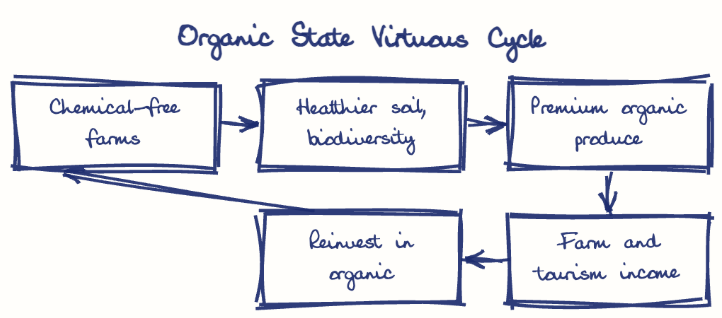
Sikkim's organic model restores soil health, keeps rivers free of chemical runoff, protects pollinators and lowers emissions, while earning premium prices, cutting input costs and boosting organic tourism. It became India's first fully organic state in January 2016 after converting about 75,000 hectares.
Model answer
Ghissu Editorial · Verified 4 Oct 2026 · 273 words
Sikkim became India's first fully organic state in January 2016, after its State Organic Mission (2010) converted about 75,000 hectares and banned chemical inputs by law; it won the Future Policy Gold Award in 2018.
Ecological Benefits of an Organic State
1. Soil health: Compost, green manure and vermicompost rebuild organic matter and moisture on fragile, erosion-prone mountain slopes. 2. Clean water: No fertiliser or pesticide runoff keeps the Teesta's feeder streams free of nitrates and residues, protecting aquatic life and drinking water. 3. Biodiversity and climate: A pesticide ban spares bees and natural predators, and organic soils store more carbon while avoiding nitrous oxide from urea.
Premium markets
GI-tagged large cardamom and Dalle Khursani chilli fetch premium prices, helped by the Mission Organic Value Chain Development for North Eastern Region (2015-16).
Lower costs
Farmers no longer buy costly chemical fertilisers and pesticides, and on-farm inputs such as compost reduce cash outlay for small holders.
Organic tourism
The organic brand draws visitors to farm homestays and village tourism, spreading income into hospitality and crafts.
Caveats
Yields dipped during conversion, many vegetables still come from the plains, and weak certification and market links still cap gains.
This model answer is indicative and the model can make mistakes; please verify key facts independently.
Practise this question
1Get the answer sheet
Sized for this question.
2Write your answer
Timed, by hand.
3Get it marked
Your score and what to fix.
This chapter in the exam
Conservation19 questions
Asked in 11 of 14 sittings since 2013
- 2026Discuss the aim and goals of Kunming-Montreal global biodiversity framework. Mention India's commitments and initiatives to achieve the goals and targets of this framework giving suitable examples. (Answer in 150 words)
- 2025What is Carbon Capture, Utilization and Storage (CCUS) ? What is the potential role of CCUS in tackling climate change ?
All 19 questions, sorted by sub-topic, with model answers and practice.
Question from the official UPSC Civil Services (Main) Examination 2018 paper. Answer written by Ghissu's engine and checked against our editorial standards. Found an error? Tell us and we correct it within 48 hours.