2018 · GS Paper 3 · Q7 · 10 marks
What is wetland? Explain the Ramsar concept of 'wise use' in the context of wetland conservation. Cite two examples of Ramsar sites from India.
In short
A wetland is any natural or artificial area of marsh, peatland or water, including shallow marine water, and Ramsar's wise use means maintaining its ecological character while people use it sustainably. Chilika Lake in Odisha left the Montreux Record in 2002 after its sea mouth was reopened.
Model answer
Ghissu Editorial · Verified 4 Oct 2026 · 273 words
Wetland defined
Under Article 1 of the Convention, a wetland is any area of marsh, fen, peatland or water, natural or artificial, permanent or temporary, fresh, brackish or salt, including marine water up to six metres deep at low tide.
Wise use
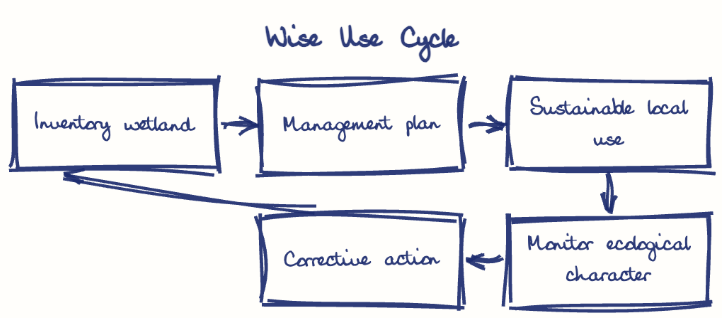
It means maintaining a wetland's ecological character through ecosystem approaches within sustainable development, so fishing, grazing and tourism continue only while the wetland's functions survive.
Instruments
Parties apply wise use through wetland policies, inventories, management plans and community participation, list degrading sites on the Montreux Record, and in India the Wetlands Rules, 2017 bar reclamation and encroachment.
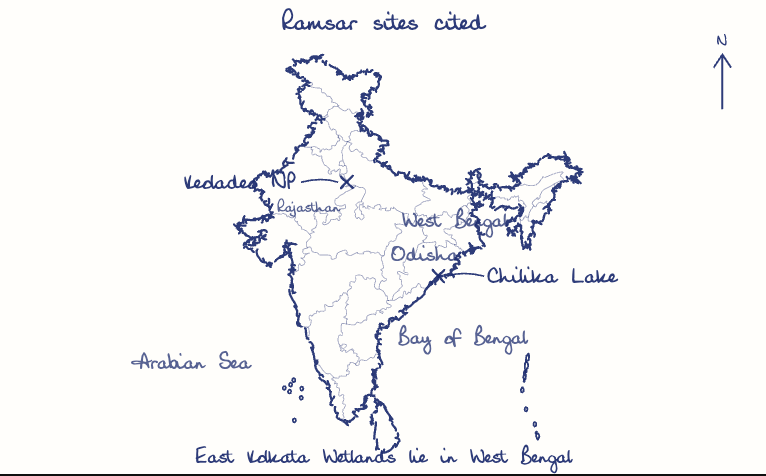
Chilika Lake, Odisha
Placed on the Montreux Record in 1993, it recovered after the Chilika Development Authority opened a new sea mouth in 2000 and left the Record in 2002.
Keoladeo National Park, Rajasthan
One of India's first Ramsar sites (1981), it remains on the Montreux Record because water from the Panchna dam is unreliable.
East Kolkata Wetlands
Designated in 2002, its sewage-fed fisheries treat Kolkata's wastewater while producing fish and vegetables, a classic wise-use model.
This model answer is indicative and the model can make mistakes; please verify key facts independently.
Practise this question
1Get the answer sheet
Sized for this question.
2Write your answer
Timed, by hand.
3Get it marked
Your score and what to fix.
This chapter in the exam
Conservation19 questions
Asked in 11 of 14 sittings since 2013
- 2026Discuss the aim and goals of Kunming-Montreal global biodiversity framework. Mention India's commitments and initiatives to achieve the goals and targets of this framework giving suitable examples. (Answer in 150 words)
- 2025What is Carbon Capture, Utilization and Storage (CCUS) ? What is the potential role of CCUS in tackling climate change ?
All 19 questions, sorted by sub-topic, with model answers and practice.
Question from the official UPSC Civil Services (Main) Examination 2018 paper. Answer written by Ghissu's engine and checked against our editorial standards. Found an error? Tell us and we correct it within 48 hours.