2018 · GS Paper 4 · Q4(a) · 10 marks
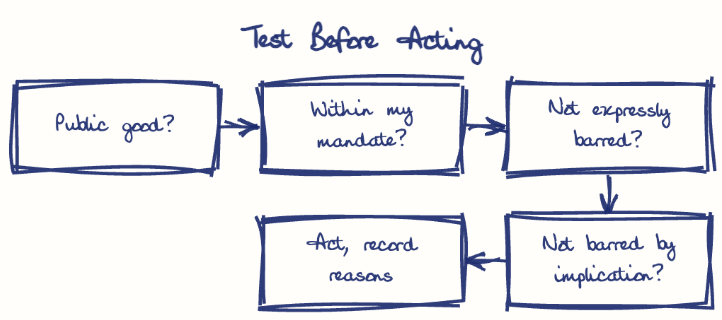
"In doing a good thing, everything is permitted which is not prohibited expressly or by clear implication." Examine the statement with suitable examples in the context of a public servant discharging his/her duties.
In short
The statement is only partly valid for a public servant: it supports initiative and compassion within conferred discretion, but official power exists only where law confers it. The Supreme Court's 2024 demolition ruling and Prakash Kadam (2011) show that implied prohibitions and lawful means still bind.
Model answer
Ghissu Editorial · Verified 4 Oct 2026 · 281 words
Initiative within discretion
No law foresees everything; Armstrong Pame, SDM of Tousem in Manipur, built the 100-km "People's Road" in 2012 through public donations when no project existed.
Compassion within the mandate
Kozhikode Collector N. Prasanth's Operation Sulaimani (2015) used local hotels to feed the hungry free, with no forbidden means.
Against rule-bound paralysis
The Second ARC's Citizen Centric Administration report (2009) asked officials to value outcomes over procedure.
Power must be conferred
An officer acting without legal authority acts ultra vires even with good motives, as Article 300A shows for property.
Implied prohibitions bind
The Supreme Court's November 2024 demolition ruling held that razing an accused person's house as punishment breaches due process, and required a 15-day notice.
Ends never cleanse means
Prakash Kadam (2011) called fake encounters cold-blooded murder and told police to refuse illegal orders.
"Good" is not self-certified
Coercive sterilisation drives of the Emergency, recorded by the Shah Commission, were pursued as public good.
This model answer is indicative and the model can make mistakes; please verify key facts independently.
Practise this question
1Get the answer sheet
Sized for this question.
2Write your answer
Timed, by hand.
3Get it marked
Your score and what to fix.
This chapter in the exam
Laws, rules, regulations and conscience as sources of ethical guidance16 questions
Asked in 9 of 14 sittings since 2013
- 2026Dr. B. R. Ambedkar had cautioned that employing civil disobedience within a constitutional democracy equates to endorsing 'anarchy'. How should modern democracies navigate the ethical dilemmas posed by civil disobedience movements that aim to promote social justice against policies that may raise genuine concerns?
- 2026Usually schools, working in remote areas, do not fully comply with government regulations. However, if the rules are enforced strictly, it would lead to most schools closing down. How should an administrator strike a balance between enforcement of rules and educational rights of children?
All 16 questions, sorted by sub-topic, with model answers and practice.
Question from the official UPSC Civil Services (Main) Examination 2018 paper. Answer written by Ghissu's engine and checked against our editorial standards. Found an error? Tell us and we correct it within 48 hours.