2018 · GS Paper 4 · Q2(a) · 10 marks
What is meant by public interest? What are the principles and procedures to be followed by the civil servants in public interest?
In short
Public interest is the welfare of the community as a whole, including the voiceless and future generations, as distinct from private or sectional gain. Civil servants serve it through constitutional allegiance, Nolan-style objectivity and procedures such as natural justice, declared conflicts of interest and written, reasoned orders.
Model answer
Ghissu Editorial · Verified 4 Oct 2026 · 283 words
Not mere majority
It includes the voiceless and future generations, which is why Gandhi's talisman asks us to recall the poorest person.
Balanced against rights
Section 8(2) of the RTI Act uses it to override exemptions, yet Puttaswamy (2017) requires any state action to be proportionate.
Constitutional allegiance
The Draft Public Services Bill, 2007 lists allegiance to the Constitution, good governance and apolitical functioning as core values.
Selflessness and objectivity
Nolan's principles demand decisions on merit and evidence alone, without favour to kin, caste or party.
Concern for the weakest
Rawls's difference principle and Antyodaya ask that public choices benefit the least advantaged.
Natural justice
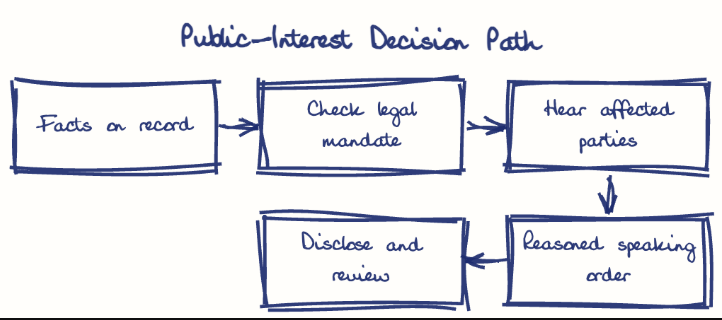
Hearing affected parties and avoiding bias give effect to the fair procedure of Maneka Gandhi (1978).
Declare conflicts
The 2014 amendment to the AIS (Conduct) Rules makes officers declare private interests and resolve conflicts to protect the public interest.
Written instructions
T.S.R. Subramanian (2013) asked officers to act on written orders so responsibility can be traced.
This model answer is indicative and the model can make mistakes; please verify key facts independently.
Practise this question
1Get the answer sheet
Sized for this question.
2Write your answer
Timed, by hand.
3Get it marked
Your score and what to fix.
This chapter in the exam
Probity in Governance — Concept of public service8 questions
Asked in 6 of 14 sittings since 2013
- 2024"In Indian culture and value system, an equal opportunity has been provided irrespective of gender identity. The number of women in public service has been steadily increasing over the years." Examine the gender-specific challenges faced by female public servants and suggest suitable measures to increase their efficiency in discharging their duties and maintaining high standards of probity.
- 2023'Probity is essential for an effective system of governance and socio-economic development.' Discuss.
All 8 questions, sorted by sub-topic, with model answers and practice.
Question from the official UPSC Civil Services (Main) Examination 2018 paper. Answer written by Ghissu's engine and checked against our editorial standards. Found an error? Tell us and we correct it within 48 hours.