2019 · GS Paper 1 · Q4 · 10 marks
Assess the impact of global warming on the coral life system with examples.
In short
Global warming harms coral life mainly through heat-driven bleaching, aided by acidification, stronger storms and disease, threatening reef biodiversity, island livelihoods and coastal protection. NOAA's fourth global bleaching event, declared in 2024, had touched about 84% of the world's reef area by 2025.
Model answer
Ghissu Editorial · Verified 4 Oct 2026 · 269 words
Coral reefs cover under 1% of the seafloor yet shelter about a quarter of marine species, within a narrow band of warm, clear water. Global warming is pushing them past it: NOAA's fourth global bleaching event, declared in 2024, had touched about 84% of reef area by 2025.
How Global Warming Stresses the Coral Life System
Warming Threats to Corals effect: Coral reef decline → Ocean heat stress → Acidification → Sea-level rise → Stronger cyclones → Disease outbreaks
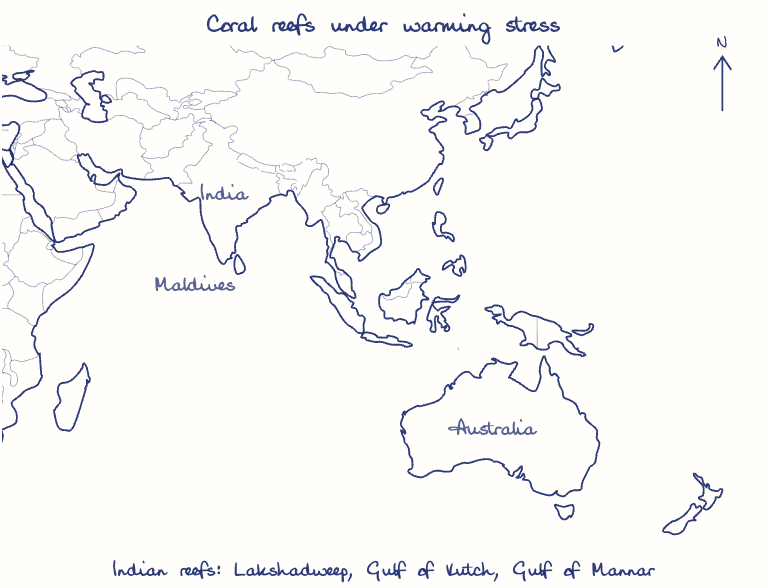
1. Thermal bleaching: About 1°C above the summer maximum for weeks makes polyps expel their zooxanthellae; the Great Barrier Reef bleached five times in 2016-2024, and Lakshadweep in 2024. 2. Ocean acidification: Surface pH has fallen about 0.1 since pre-industrial times, slowing the building of carbonate skeletons. 3. Seas, storms and disease: Fiercer cyclones break weakened reefs, and heat-stressed corals fall to diseases such as stony coral tissue loss disease in Florida.
Biodiversity collapse
The IPCC (2018) projected a 70-90% loss of warm-water corals at 1.5°C and over 99% at 2°C.
Livelihoods and coasts
Tourism is about 30% of GDP in Small Island Developing States (Global Ocean Accounts Partnership, 2024), and reefs absorb about 97% of wave energy.
Limited resilience
Gulf of Kutch corals tolerate heat, and the Great Barrier Reef hit record cover in 2022, but mostly of fast-growing Acropora that bleaches first.
This model answer is indicative and the model can make mistakes; please verify key facts independently.
Practise this question
1Get the answer sheet
Sized for this question.
2Write your answer
Timed, by hand.
3Get it marked
Your score and what to fix.
This chapter in the exam
Water (Oceans)4 questions
Asked in 4 of 14 sittings since 2013
- 2025What are Tsunamis? How and where are they formed? What are their consequences? Explain with examples.
- 2024What is sea surface temperature rise? How does it affect the formation of tropical cyclones?
All 4 questions, sorted by sub-topic, with model answers and practice.
Question from the official UPSC Civil Services (Main) Examination 2019 paper. Answer written by Ghissu's engine and checked against our editorial standards. Found an error? Tell us and we correct it within 48 hours.