2019 · GS Paper 1 · Q3 · 10 marks
Examine the linkages between the nineteenth century’s ‘Indian Renaissance’ and the emergence of national identity.
In short
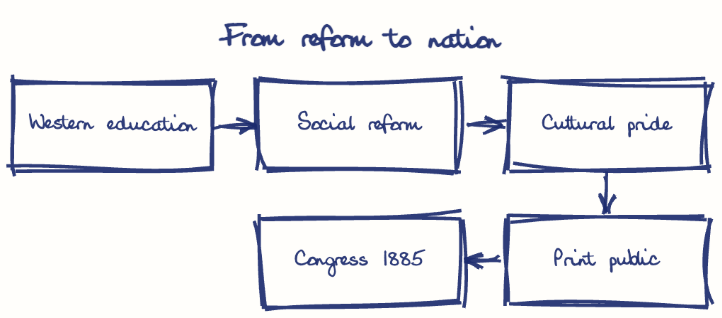
The nineteenth-century Indian Renaissance built national identity by answering the colonial civilising mission, restoring pride in a shared past and creating a print public sphere that fed the Congress. Its base, however, stayed elite, upper-caste and religious in idiom, as Phule's Gulamgiri (1873) charged.
Model answer
Ghissu Editorial · Verified 4 Oct 2026 · 267 words
Reform answered the civilising mission
Rammohan Roy's campaign against sati (banned 1829) and Vidyasagar's Widow Remarriage Act (1856) showed Indians could reform themselves.
Pride in a shared past
Dayananda's Arya Samaj (1875) and Vivekananda's Chicago address (1893) restored civilisational confidence.
Print public sphere
Bankim Chandra's Anandamath (1882), with Vande Mataram, helped readers across regions imagine one nation.
Reformers became nationalists
M.G. Ranade moved from the Prarthana Samaj to moderate politics, and Arya Samaj schools shaped Lala Lajpat Rai.
Elite base
Its leaders were English-educated, upper-caste and urban, mostly in Bengal, Bombay and Madras.
Religious idiom divided
Shuddhi and cow-protection campaigns alarmed Muslims, while Sayyid Ahmad Khan urged Muslims to keep away from the Congress.
Caste left out
Jyotirao Phule's Gulamgiri (1873) charged that upper-caste reform ignored Shudras and Atishudras.
Borrowed frame
Its reliance on the Orientalist golden-age story fits Partha Chatterjee's critique of nationalist thought as a "derivative discourse".
This model answer is indicative and the model can make mistakes; please verify key facts independently.
Practise this question
1Get the answer sheet
Sized for this question.
2Write your answer
Timed, by hand.
3Get it marked
Your score and what to fix.
This chapter in the exam
Socio-Religious Reform Movements4 questions
Asked in 4 of 14 sittings since 2013
- 2025Mahatma Jotirao Phule's writings and efforts of social reforms touched issues of almost all subaltern classes. Discuss.
- 2021Trace the rise and growth of socio-religious reform movements with special reference to Young Bengal and Brahmo Samaj.
All 4 questions, sorted by sub-topic, with model answers and practice.
Question from the official UPSC Civil Services (Main) Examination 2019 paper. Answer written by Ghissu's engine and checked against our editorial standards. Found an error? Tell us and we correct it within 48 hours.