2019 · GS Paper 1 · Q1 · 10 marks
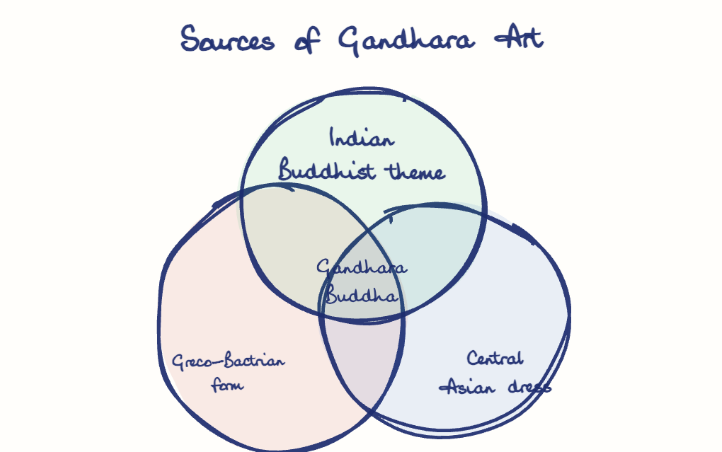
Highlight the Central Asian and Greco-Bactrian elements in the Gandhara art.
In short
Gandhara art took its Apollo-like Buddha, toga-like drapery, anatomical realism and Corinthian motifs from Greco-Bactrian art, and its steppe dress, princely Bodhisattvas and Iranian deities from Central Asia. The Fasting Buddha of Sikri and Kanishka's coins show both strands.
Model answer
Ghissu Editorial · Verified 4 Oct 2026 · 264 words
Apollo-like Buddha
An oval, idealised face and wavy hair over the ushnisha follow Greek images of Apollo.
Toga-like drapery
Heavy robes with deep, rhythmic folds and the contrapposto stance come from Greco-Roman sculpture.
Anatomical realism
The Fasting Buddha from Sikri, now in the Lahore Museum, shows ribs and veins with Hellenistic realism.
Classical motifs
Corinthian capitals from Jamal Garhi, Atlas figures, garland-bearing cupids and Heracles as Vajrapani come from the Greek repertoire.
Steppe dress
Kings and donors wear the tunic, trousers, boots and belted coat that Kanishka wears on his coins.
Princely Bodhisattvas
Moustached, turbaned and jewelled Bodhisattvas look like Kushan nobles.
Iranian fire and gods
Flaming-shouldered Buddhas from Kapisa and the Kushan deities Pharro and Ardochsho bring Iranian beliefs into Buddhist art.
Silk Route reach
Schist and stucco workshops at Taxila and Hadda served monasteries on the trade routes and carried the style to Bamiyan and China.
This model answer is indicative and the model can make mistakes; please verify key facts independently.
Practise this question
1Get the answer sheet
Sized for this question.
2Write your answer
Timed, by hand.
3Get it marked
Your score and what to fix.
This chapter in the exam
Art Forms10 questions
Asked in 8 of 14 sittings since 2013
- 2025The sculptors filled the Chandella artform with resilient vigor and breadth of life.' Elucidate.
- 2022Discuss the significance of the lion and bull figures in Indian mythology, art and architecture.
All 10 questions, sorted by sub-topic, with model answers and practice.
Question from the official UPSC Civil Services (Main) Examination 2019 paper. Answer written by Ghissu's engine and checked against our editorial standards. Found an error? Tell us and we correct it within 48 hours.