2019 · GS Paper 1 · Q11 · 15 marks
Many voices had strengthened and enriched the nationalist movement during the Gandhian phase. Elaborate
In short
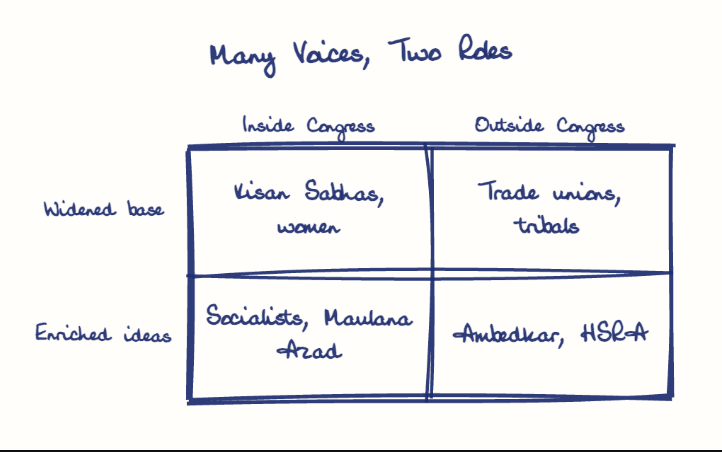
In the Gandhian phase peasants, workers, women and tribals strengthened the national movement's mass base, while depressed-class, socialist and revolutionary voices enriched its idea of freedom. Ambedkar's Mahad satyagraha and the Poona Pact, and the Karachi Resolution of 1931, put social justice and economic equality on the nationalist agenda.
Model answer
Ghissu Editorial · Verified 4 Oct 2026 · 291 words
Peasants and workers
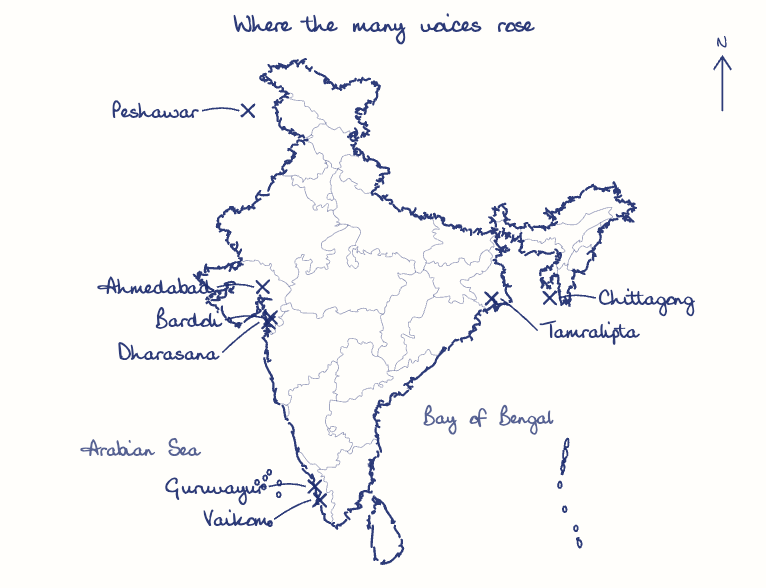
The Awadh Kisan Sabha (1920), the Bardoli satyagraha (1928) and the AITUC (1920) tied agrarian and labour grievances to the anti-colonial cause.
Women
Sarojini Naidu led the Dharasana salt raid (1930), and in 1942 Aruna Asaf Ali and Matangini Hazra showed women leading the struggle.
Tribals and the frontier
The Tana Bhagats adopted khadi, and Ghaffar Khan's Khudai Khidmatgars (1929) made the frontier a bastion of non-violence.
Depressed classes
Vaikom (1924-25), Ambedkar's Mahad satyagraha (1927) and the Poona Pact (1932) forced social justice on to the nationalist agenda.
Socialists
The Karachi Resolution (1931) and the Congress Socialist Party (1934) gave the movement an economic programme for the poor.
Revolutionaries
Bhagat Singh's HSRA (1928) gave youth a voice of sacrifice and sharpened the demand for complete independence.
Plural nationalism
The lesson is that a diverse democracy stays strong only by hearing caste, regional and minority voices, as Article 17 and reservations later did.
This model answer is indicative and the model can make mistakes; please verify key facts independently.
Practise this question
1Get the answer sheet
Sized for this question.
2Write your answer
Timed, by hand.
3Get it marked
Your score and what to fix.
This chapter in the exam
Role of Masses and Personalities13 questions
Asked in 8 of 14 sittings since 2013
- 2026The significance of the Gandhian movements lay in the masses they mobilized. Elucidate.
- 2021Bring out the constructive programmes of Mahatma Gandhi during Non-Cooperation Movement and Civil Disobedience Movement.
All 13 questions, sorted by sub-topic, with model answers and practice.
Question from the official UPSC Civil Services (Main) Examination 2019 paper. Answer written by Ghissu's engine and checked against our editorial standards. Found an error? Tell us and we correct it within 48 hours.