2019 · GS Paper 1 · Q14 · 15 marks
What is water stress? How and why does it differ regionally in India?
In short
Water stress is demand for usable freshwater exceeding renewable supply, and in India it appears as groundwater mining in the north-west, thin storage in the peninsula, unsafe water in the Gangetic plain and seasonal shortage in the hills. The CGWB's 2025 assessment found 730 of 6,762 units over-exploited.
Model answer
Ghissu Editorial · Verified 4 Oct 2026 · 283 words
North-west mines groundwater
Punjab, Haryana and Rajasthan extract more than they recharge; the CGWB's 2025 assessment found 730 of 6,762 units over-exploited.
Peninsula lacks storage
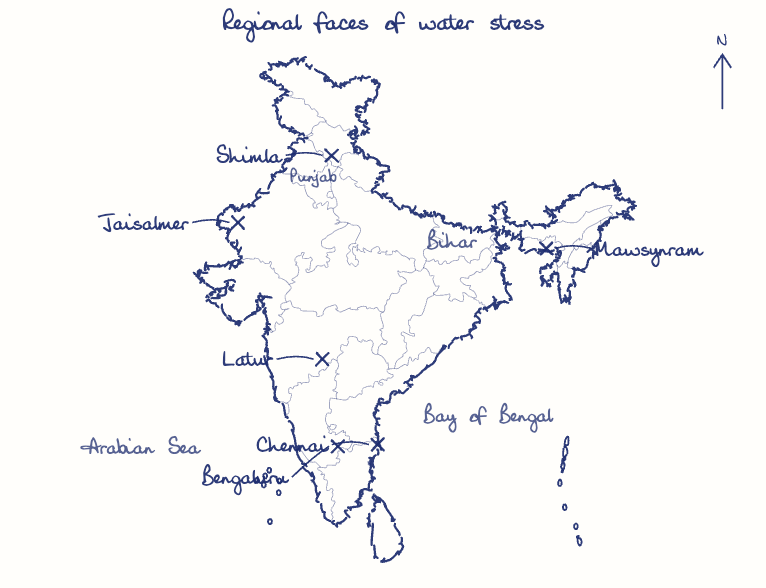
Hard-rock aquifers store little, so droughts bring crises like Latur's water train (2016) and Chennai's dry reservoirs (2019).
Plains and hills
Arsenic in Bihar and West Bengal creates quality stress, while steep slopes and drying springs left Shimla short of water in 2018 despite heavy Himalayan rainfall.
Rainfall and geology
Rainfall ranges from over 11,000 mm at Mawsynram to under 200 mm around Jaisalmer, and deep alluvium stores far more than Deccan basalt.
Demand and policy
Agriculture uses about 80% of India's water, and free farm power pushes paddy into Punjab and sugarcane into Marathwada, while cities like Bengaluru pave over recharge zones.
Region-specific management
NAQUIM aquifer maps, village water budgets under Atal Bhujal Yojana, micro-irrigation under PMKSY and recharge structures in hard-rock areas should match each region's form of stress.
This model answer is indicative and the model can make mistakes; please verify key facts independently.
Practise this question
1Get the answer sheet
Sized for this question.
2Write your answer
Timed, by hand.
3Get it marked
Your score and what to fix.
This chapter in the exam
Resources and planning38 questions
Asked in 14 of 14 sittings since 2013
- 2026"Water resources are both an asset and a source of conflict in South Asia." Examine this statement giving examples.
- 2026Analyze the role of satellite-based technologies in achieving climate-smart agriculture and food security in India.
All 38 questions, sorted by sub-topic, with model answers and practice.
Question from the official UPSC Civil Services (Main) Examination 2019 paper. Answer written by Ghissu's engine and checked against our editorial standards. Found an error? Tell us and we correct it within 48 hours.