2019 · GS Paper 2 · Q4 · 10 marks
From the resolution of contentious issues regarding distribution of legislative powers by the courts, Principle of Federal Supremacy and Harmonious Construction have emerged. Explain.
In short
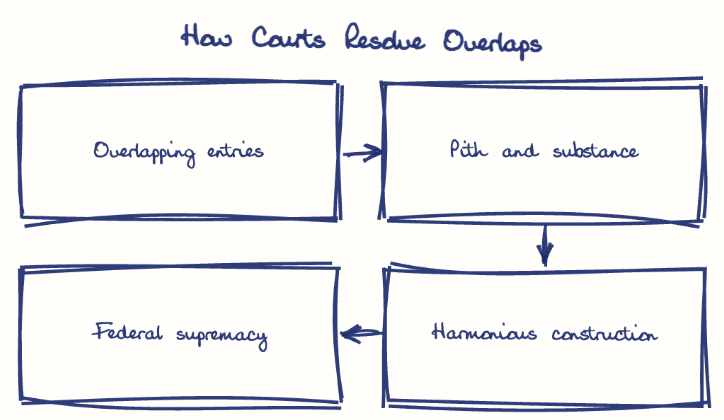
When legislative entries overlap, courts first read them harmoniously so each operates in its own field, and only if conflict is irreconcilable does the Union law prevail under Articles 246(1) and 254. Mineral Area Development Authority v. SAIL (2024) reconciled the Union's mining entry with the states' power to tax mineral rights.
Model answer
Ghissu Editorial · Verified 4 Oct 2026 · 278 words
Textual basis
Article 246(1) gives Parliament power over the Union List "notwithstanding" clauses (2) and (3), so in an irreconcilable overlap the Union entry prevails.
Concurrent repugnancy
Under Article 254(1) a central law prevails over a conflicting state law, judged by the M. Karunanidhi (1979) tests, though Article 254(2) saves a state law that receives the President's assent.
Applied
In Adhiyaman Educational Institute (1995), Tamil Nadu's rules on technical education gave way to the AICTE Act, made under the Union entry on coordination and standards.
Reconcile first
Courts identify a law's pith and substance and read overlapping entries so that each operates in its own field, because the lists are meant to coexist and no entry should be rendered meaningless.
Classic illustration
The Federal Court's motor spirit case (1939) upheld both the federal excise on manufacture and the provincial tax on sale.
Reading together
Gujarat University v. Mudholkar (1963) let a state set the medium of instruction only so far as the Union's power over standards was unaffected.
This model answer is indicative and the model can make mistakes; please verify key facts independently.
Practise this question
1Get the answer sheet
Sized for this question.
2Write your answer
Timed, by hand.
3Get it marked
Your score and what to fix.
This chapter in the exam
Functions and Responsibilities of the Union and the States7 questions
Asked in 7 of 14 sittings since 2013
- 2026How far has the Indian federal framework been successful in accommodating regional and cultural diversities ? Highlight the role of asymmetric federalism and suggest measures to make dispute resolution mechanisms more effective.
- 2025Examine the evolving pattern of Centre-State financial relations in the context of planned development in India. How far have the recent reforms impacted the fiscal federalism in India?
All 7 questions, sorted by sub-topic, with model answers and practice.
Question from the official UPSC Civil Services (Main) Examination 2019 paper. Answer written by Ghissu's engine and checked against our editorial standards. Found an error? Tell us and we correct it within 48 hours.