2019 · GS Paper 2 · Q8 · 10 marks
Implementation of information and Communication Technology (ICT) based Projects / Programmes usually suffers in terms of certain vital factors. Identify these factors, and suggest measures for their effective implementation.
In short
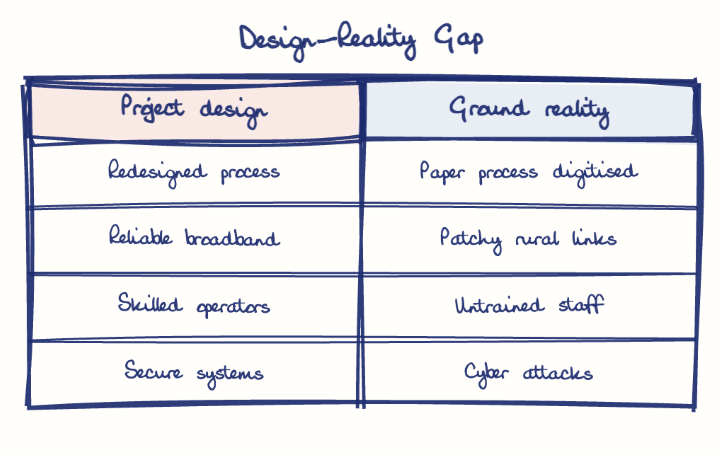
ICT projects falter mainly because unreformed processes, connectivity gaps, untrained staff, weak monitoring and cyber insecurity open a gap between design and reality. The CAG found the National Knowledge Network's outlay revised to ₹6,548.20 crore after four extensions up to March 2024.
Model answer
Ghissu Editorial · Verified 4 Oct 2026 · 289 words
Process not re-engineered
Projects automate old procedures, so citizens still face multiple approvals after applying online.
Connectivity gaps
BharatNet, planned in 2011 for about 2.5 lakh gram panchayats, had connected over 2.14 lakh by 2025.
Human capacity
Low user digital literacy and a shortage of skilled staff, flagged by the Expert Committee on HR Policy for e-Governance (2013), leave systems underused.
Weak project governance
The CAG (Report No. 1 of 2025) found the National Knowledge Network's outlay revised to ₹6,548.20 crore after four extensions, and the AIIMS Delhi ransomware attack (2022) exposed weak cyber security.
Transformation, not translation
Re-engineer processes before coding, as e-Kranti (2015) prescribes, and design services around citizens' life events.
Capacity building
Train staff through Mission Karmayogi (2020) and its iGOT platform and keep dedicated e-governance teams.
Outcome-based monitoring
Use PRAGATI-style dashboards with fixed accountability and tie vendor payments to service-level agreements and third-party audits.
Secure, interoperable platforms
Build on API Setu and DigiLocker, with CERT-In's six-hour incident reporting rule (2022) and the Digital Personal Data Protection Act, 2023.
This model answer is indicative and the model can make mistakes; please verify key facts independently.
Practise this question
1Get the answer sheet
Sized for this question.
2Write your answer
Timed, by hand.
3Get it marked
Your score and what to fix.
This chapter in the exam
e-Governance — Applications, Models, Successes, Limitations and Potential6 questions
Asked in 6 of 14 sittings since 2013
- 2025e-governance projects have a built-in bias towards technology and back-end integration than user-centric designs. Examine.
- 2024e-governance is not just about the routine application of digital technology in service delivery process. It is as much about multifarious interactions for ensuring transparency and accountability. In this context evaluate the role of the Interactive Service Model of e-governance.
All 6 questions, sorted by sub-topic, with model answers and practice.
Question from the official UPSC Civil Services (Main) Examination 2019 paper. Answer written by Ghissu's engine and checked against our editorial standards. Found an error? Tell us and we correct it within 48 hours.