2025 · GS Paper 2 · Q7 · 10 marks
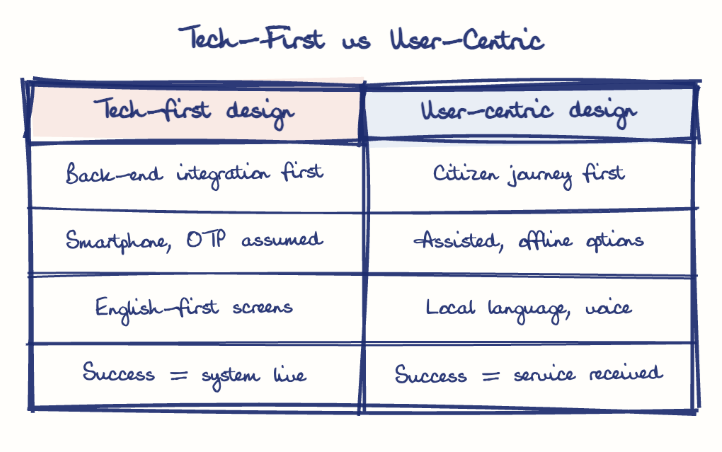
e-governance projects have a built-in bias towards technology and back-end integration than user-centric designs. Examine.
In short
Many Indian e-governance projects do favour technology and back-end integration over user-centric design, a pattern Richard Heeks called the design-reality gap. GST Network and income-tax portal glitches and CoWIN's initial online-only registration show the bias, while DigiLocker, Bhashini and NeSDA show it is correctable.
Model answer
Ghissu Editorial · Verified 4 Oct 2026 · 315 words
Launch before usability
The GST Network's 2017 glitches forced the suspension of planned return forms, and the 2021 income-tax portal faltered so badly that the Finance Minister summoned Infosys.
Assumed access
CoWIN first required online registration for 18-44 year olds (May 2021), excluding many rural and less digitally literate citizens until walk-in registration was allowed.
Rigid authentication
The NMMS app's geotagged attendance for MGNREGA (2023) and PDS biometrics in Jharkhand shifted connectivity failures onto the poorest users.
Unreformed processes
Forms are digitised without re-engineering, so citizens still upload documents the state already holds, as the 2nd ARC (2008) warned.
Useful integration
DigiLocker, with 53.92 crore users (PIB, 2025), shows that back-end integration can itself spare citizens paperwork.
Inclusion features
Bhashini's AI translation and Common Service Centres widen reach beyond smartphone owners.
Measuring the citizen
DARPG's NeSDA rates portals on accessibility, ease of use and end-service delivery, not merely on whether they exist.
Proven redesigns
Passport Seva rebuilt the application journey around the applicant.
This model answer is indicative and the model can make mistakes; please verify key facts independently.
Practise this question
1Get the answer sheet
Sized for this question.
2Write your answer
Timed, by hand.
3Get it marked
Your score and what to fix.
This chapter in the exam
e-Governance — Applications, Models, Successes, Limitations and Potential6 questions
Asked in 6 of 14 sittings since 2013
- 2024e-governance is not just about the routine application of digital technology in service delivery process. It is as much about multifarious interactions for ensuring transparency and accountability. In this context evaluate the role of the Interactive Service Model of e-governance.
- 2023e-governance, as a critical tool of governance, has ushered in effectiveness, transparency and accountability in governments. What inadequacies hamper the enhancement of these features?
All 6 questions, sorted by sub-topic, with model answers and practice.
Question from the official UPSC Civil Services (Main) Examination 2025 paper. Answer written by Ghissu's engine and checked against our editorial standards. Found an error? Tell us and we correct it within 48 hours.