2019 · GS Paper 2 · Q13 · 15 marks
"The reservation of seats for women in the institutions of local self-government has had a limited impact on the patriarchal character of the Indian Political Process." Comment.
In short
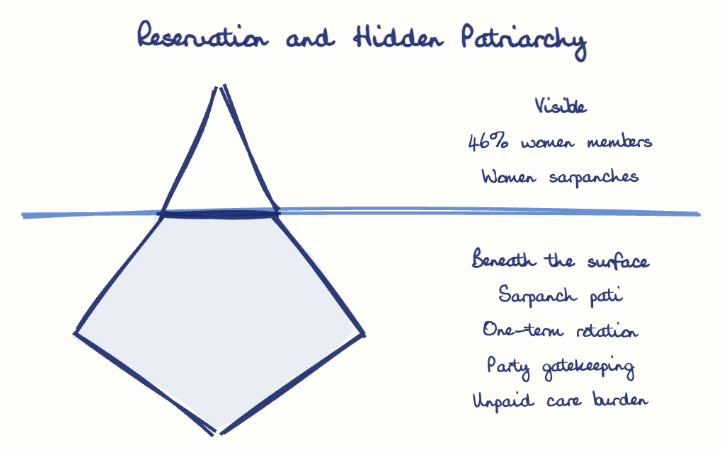
Reservation has changed local priorities and attitudes but only marginally dented the patriarchal political process, which proxy rule, rotation and party gatekeeping keep intact. Women hold about 46% of panchayat seats, yet the 2019 Lok Sabha had only 78 women.
Model answer
Ghissu Editorial · Verified 4 Oct 2026 · 285 words
Policy priorities
Duflo and Chattopadhyay (2004) found women pradhans in West Bengal and Rajasthan invested more in drinking water and goods women demanded.
Shifting attitudes
Exposure to women leaders in West Bengal weakened voter bias and raised parents' aspirations for daughters.
Voice
Over a million women leaders, and sarpanches like Chhavi Rajawat of Soda, show women governing on their own terms.
Proxy rule
The "sarpanch pati" problem led the Ministry to set up the Sushil Kumar Committee in 2023, which recommended penalties for proxy representation.
Rotation
In most states seats rotate every term, so many women serve only once.
Gatekeeping
Parties rarely field women for Assembly and Lok Sabha seats, and the 106th Amendment (2023) waits on delimitation.
Exclusionary norms
Education conditions upheld in Rajbala v. State of Haryana (2015) and unpaid care keep poorer women out.
Reform the mechanics
Penalise proxy rule, keep reserved seats for two terms, and train women through the Rashtriya Gram Swaraj Abhiyan linked to SHG federations.
This model answer is indicative and the model can make mistakes; please verify key facts independently.
Practise this question
1Get the answer sheet
Sized for this question.
2Write your answer
Timed, by hand.
3Get it marked
Your score and what to fix.
This chapter in the exam
Women6 questions
Asked in 6 of 14 sittings since 2013
- 2026“Women as a class neither belong to a minority group nor are they regarded as forming a backward class.” In the light of this statement, discuss the evolution of women’s reservation from local bodies to Parliament.
- 2025Women's social capital complements in advancing empowerment and gender equity. Explain.
All 6 questions, sorted by sub-topic, with model answers and practice.
Question from the official UPSC Civil Services (Main) Examination 2019 paper. Answer written by Ghissu's engine and checked against our editorial standards. Found an error? Tell us and we correct it within 48 hours.