2026 · GS Paper 2 · Q2 · 10 marks
“Women as a class neither belong to a minority group nor are they regarded as forming a backward class.” In the light of this statement, discuss the evolution of women’s reservation from local bodies to Parliament.
In short
Because women are neither a minority nor a backward class, their reservation rests on Article 15(3) and express amendments, reaching panchayats in 1993 and Parliament in 2023. The 106th Amendment reserves one-third of legislative seats, but only after census and delimitation.
Model answer
Ghissu Editorial · Verified 4 Oct 2026 · 292 words
Early hesitation
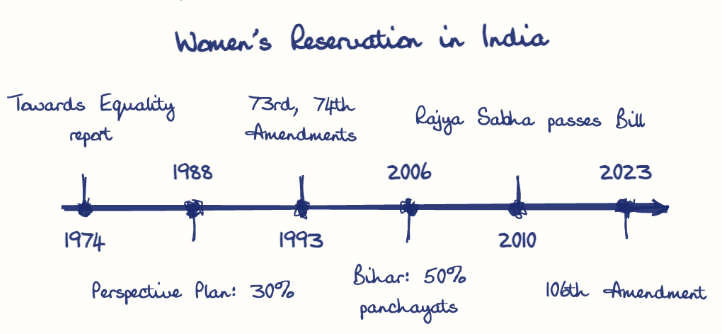
The Towards Equality report (1974) rejected legislative quotas, but the National Perspective Plan (1988) sought 30% in local bodies, and Karnataka reserved 25% of Mandal Panchayat seats in 1983.
Constitutional mandate
The 73rd and 74th Amendments reserved one-third of seats and chairpersons' posts under Articles 243D and 243T; K. Krishna Murthy (2010) treated this as distinct from Articles 15(4) and 16(4).
Deepening at the base
Bihar's 50% quota (2006), copied by over 20 states, means women hold about half (49.75%) of panchayat seats.
Failed attempts
The 81st Amendment Bill (1996) lapsed, and the 108th passed the Rajya Sabha in 2010 but died in 2014.
106th Amendment, 2023
Articles 330A and 332A reserve one-third of Lok Sabha and assembly seats, including within SC and ST seats, for 15 years.
Conditional rollout
The quota awaits census and delimitation, a 2026 amendment bill fell in the Lok Sabha, and there is no OBC sub-quota.
This model answer is indicative and the model can make mistakes; please verify key facts independently.
Practise this question
1Get the answer sheet
Sized for this question.
2Write your answer
Timed, by hand.
3Get it marked
Your score and what to fix.
This chapter in the exam
Women6 questions
Asked in 6 of 14 sittings since 2013
- 2025Women's social capital complements in advancing empowerment and gender equity. Explain.
- 2023Explain the constitutional perspectives of Gender Justice with the help of relevant Constitutional Provisions and case laws.
All 6 questions, sorted by sub-topic, with model answers and practice.
Question from the official UPSC Civil Services (Main) Examination 2026 paper. Answer written by Ghissu's engine and checked against our editorial standards. Found an error? Tell us and we correct it within 48 hours.