2025 · GS Paper 2 · Q6 · 10 marks
Women's social capital complements in advancing empowerment and gender equity. Explain.
In short
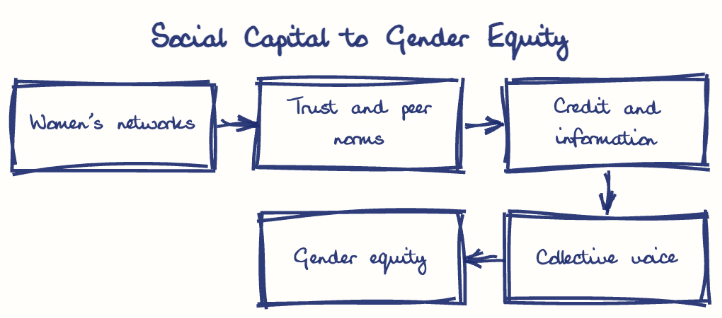
Women's social capital, their networks, norms and trust, complements legal and economic empowerment by turning individual disadvantage into collective bargaining power. DAY-NRLM's 90 lakh self-help groups of about 10 crore women show how peer trust opens credit and voice.
Model answer
Ghissu Editorial · Verified 4 Oct 2026 · 268 words
Bonding capital and credit
DAY-NRLM organises about 10 crore women in over 90 lakh SHGs, where peer trust replaces collateral and bank linkage opens formal credit.
Bridging capital and markets
Kerala's Kudumbashree links neighbourhood groups to panchayats for microenterprise, giving women income and a public role.
Linking capital and policy
Bihar's JEEViKA women demanded prohibition in 2015, and the state enacted it in 2016.
Voice for informal workers
SEWA, founded by Ela Bhatt in 1972, won credit, insurance and recognition for self-employed women.
Resources still needed
In Naila Kabeer's terms, networks become agency only with assets, yet women operated only about 14% of landholdings (Agriculture Census 2015-16).
Dark side of bonding
Closed kin networks can enforce patriarchy, as khap diktats checked in Shakti Vahini (2018) show.
Elite capture
Groups can exclude Dalit and poorer women, and "sarpanch-pati" proxies leave power with men.
This model answer is indicative and the model can make mistakes; please verify key facts independently.
Practise this question
1Get the answer sheet
Sized for this question.
2Write your answer
Timed, by hand.
3Get it marked
Your score and what to fix.
This chapter in the exam
Women6 questions
Asked in 6 of 14 sittings since 2013
- 2026“Women as a class neither belong to a minority group nor are they regarded as forming a backward class.” In the light of this statement, discuss the evolution of women’s reservation from local bodies to Parliament.
- 2023Explain the constitutional perspectives of Gender Justice with the help of relevant Constitutional Provisions and case laws.
All 6 questions, sorted by sub-topic, with model answers and practice.
Question from the official UPSC Civil Services (Main) Examination 2025 paper. Answer written by Ghissu's engine and checked against our editorial standards. Found an error? Tell us and we correct it within 48 hours.