2019 · GS Paper 3 · Q7 · 10 marks
Coastal sand mining, whether legal or illegal, poses one of the biggest threats to our environment. Analyze the impact of sand mining along the Indian coasts, citing specific examples.
In short
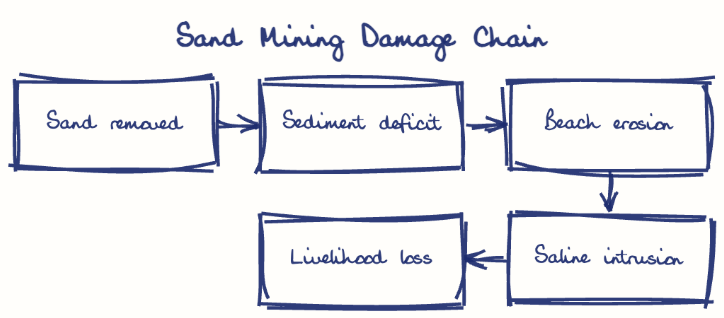
Coastal sand mining, legal or illegal, erodes beaches, flattens protective dunes, salinises aquifers and destroys fisher livelihoods, while illegal mineral trade cheats the exchequer. At Alappad in Kerala's Kollam district, mineral sand mining has eaten away much of the land, sparking the Save Alappad campaign of 2018-19.
Model answer
Ghissu Editorial · Verified 4 Oct 2026 · 275 words
Coastal erosion
At Alappad in Kerala's Kollam district, decades of mineral sand mining have eaten away much of the land between sea and backwater, sparking the Save Alappad campaign of 2018-19.
Dunes and aquifers
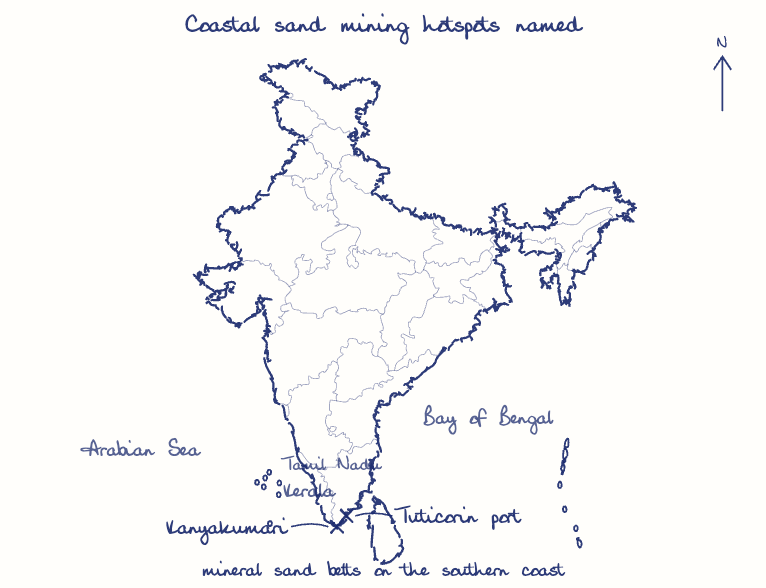
Dunes buffered Tamil Nadu villages during the 2004 tsunami, and once mined, seawater enters aquifers and fields, as in the garnet belts of Thoothukudi and Tirunelveli.
Habitat damage
Turtle nesting beaches, intertidal fauna and estuarine fish nurseries are lost to digging and turbidity, weakening the food web that coastal fisheries depend on.
Livelihoods
Fishers lose landing beaches and catch as erosion advances, which has driven village resistance to mining in Kanyakumari.
Illegal trade
The Gagandeep Singh Bedi committee set up after Tamil Nadu halted beach mineral mining in 2013, exposed large-scale illegal extraction, while thorium-bearing monazite raised radiation and strategic concerns.
Regulation
Deepak Kumar (2012) required clearance even for small leases, CRZ 2019 bars coastal sand mining except for rare minerals, and the 2020 enforcement guidelines mandate drone and GPS tracking.
This model answer is indicative and the model can make mistakes; please verify key facts independently.
Practise this question
1Get the answer sheet
Sized for this question.
2Write your answer
Timed, by hand.
3Get it marked
Your score and what to fix.
This chapter in the exam
Environmental Pollution and Degradation13 questions
Asked in 11 of 14 sittings since 2013
- 2026What are the challenges to solid waste management in India? Discuss the governmental policy framework on solid waste management. Discuss the success/failure cases of Delhi and Indore cities highlighting the salient feature of their solid waste management initiatives. (Answer in 250 words)
- 2025Examine the factors responsible for depleting groundwater in India. What are the steps taken by the government to mitigate such depletion of groundwater ?
All 13 questions, sorted by sub-topic, with model answers and practice.
Question from the official UPSC Civil Services (Main) Examination 2019 paper. Answer written by Ghissu's engine and checked against our editorial standards. Found an error? Tell us and we correct it within 48 hours.